4. Atmospheric and Oceanic Circulation

Weather and Climate: a Teachers’ Guide

Pathway: Basic Weather, Climate 

Weather in our LivesWeather MeasurementsWeather and Climate – Atmospheric and Oceanic Circulation

Lesson overviewIn this lesson we look at the pattern of circulation of the atmosphere and oceans, driven by the Sun.


What makes the whole atmosphere rotate and move? What gives us defined areas where it is generally dry or rainy, warm or cold, high pressure or low pressure? The answer to all these questions ultimately lies in the fact that we live on a spherical rotating planet, at some distance from the Sun. The incident energy from the Sun is unequally distributed between the Tropics and the Poles, with the precise patterns changing through the year. The Earth’s atmosphere and oceans are in constant motion to redistribute heat. Although temperature differences ultimately drive this, the patterns of circulation are influenced by the planet’s rotation and topography.

Learning objectives:

  • To understand why different parts of the world receive different amounts of energy from the Sun.
  • To understand how that difference in energy received by the Earth causes air and ocean water to move from equatorial regions to the poles. 
  • To be able to describe key features of how the air and water move around the globe.

Key Teaching Resources

Atmospheric and Oceanic Circulation PowerPoint
Atmospheric and Oceanic Circulation PowerPoint (easier)
Atmospheric Circulation Worksheet
Atmospheric Circulation Worksheet (easier)
Atmospheric Circulation Homework
Board Game

Teacher CPD/ Extended Reading

Read

Global Atmospheric and Oceanic Circulation – More for Teachers

Or Watch

Alternative or Extension Resources


Rubber Ducks – An Unexpected Journey – Explore what the dispersion of a cargo of rubber ducks tells us about the ocean circulation.


Weather and Climate: a Teachers’ Guide

Synoptic Weather Charts – Questions

Synoptic weather charts

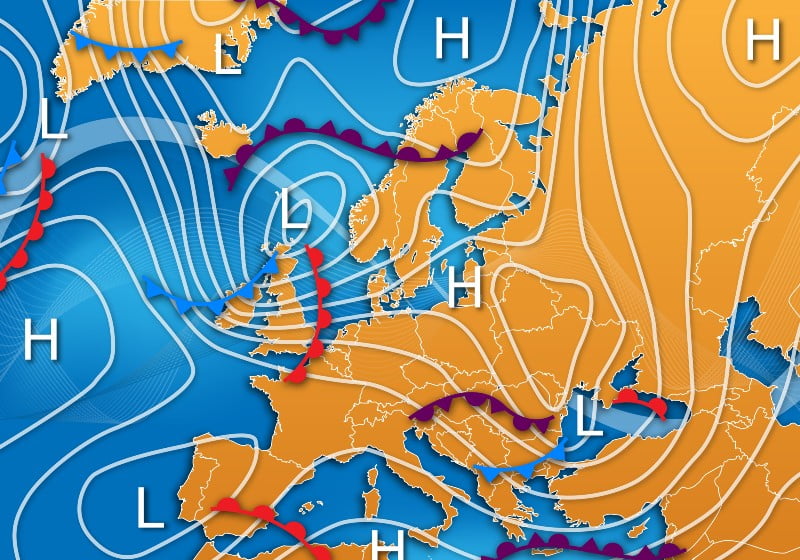
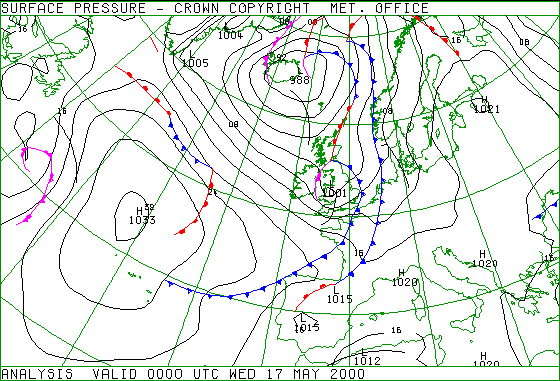
The figure below shows the synoptic pressure chart at midnight on Wednesday, 17 May.

1. Name the pressure feature running from the Baltic States (Estonia, Latvia and Lithuania) south to the Adriatic Sea.

2. What is the name of the pressure feature extending south from Iceland into Scotland, Wales and England?

3. What is type of pressure feature to the south-west of Greenland?

4. From which direction would you expect the wind direction to be blowing over south-west England?

5. Compare the pattern of isobars to the south-west of Iceland, with the pattern of isobars in the bay of Biscay.

    (a) In which area might you expect faster wind speeds?

    (b) Explain your answer, with reference to the isobar patterns.

6. Imagine that the pressure system, observed at 1033 millibars, to the west of Ireland moved east in the next 12 hours and then remained over the United Kingdom for several days.

    (a) What is the technical term given to this type of pressure system which remains stationary over the country?

    (b) Outline the weather patterns and hazards associated if this was to happen in June or July.

    (c) What differences in weather features might occur if this happened in November or December?

rainfall

Web page reproduced with the kind permission of the Met Office

Weather Symbols and Synoptic Charts

Interpreting weather charts

Introduction

Weather systems
Fronts
Relationship between isobars and wind
Understanding station plots on a weather map
Plotting a station plot

Introduction

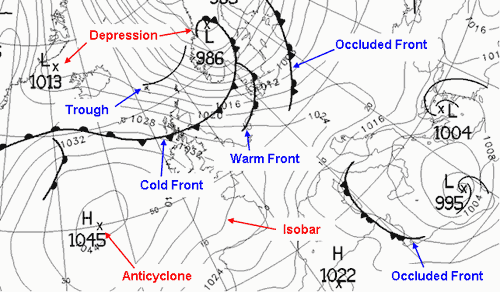
Weather charts consist of curved lines drawn on a geographical map in such a way as to indicate weather features. These features are best shown by charts of atmospheric pressure, which consist of isobars (lines of equal pressure) drawn around depressions (or lows) and anticyclones (or highs). Other features on a weather chart are fronts and troughs. These are drawn to highlight the areas of most significant weather, but that does not mean that there is nothing of significance elsewhere on the chart.

Weather systems
High pressure or anticyclones

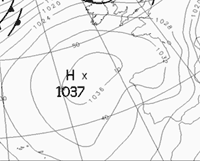
Anticyclones are areas of high pressure, whose centres are often less well defined than depressions, and are associated with quiet, settled weather. Winds blow in a clockwise direction around anticyclones in the northern hemisphere, this is reversed in the southern hemisphere.

Fig 1: An anticyclone


Low pressure or depressions

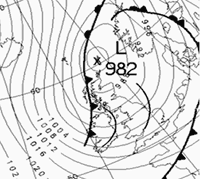
Depressions are areas of low pressure, usually with a well-defined centre, and are associated with unsettled weather. Winds blow in an anticlockwise direction around depressions in the northern hemisphere, this is reversed in the southern hemisphere.

Fig 2: A depression

 Fronts

Early weather charts consisted simply of station plots and isobars, with the weather being written as comments, like ‘Rain, heavy at times’. During the 1920s, a group of Scandinavian meteorologists, known collectively as the Bergen School, developed the concept of representing the atmosphere in terms of air masses. Since the air masses could be considered as being in conflict with each other, the term ‘front’ was used to describe the boundary between them. Three types of front were identified which depend on the relative movement of the air masses.

Cold Front

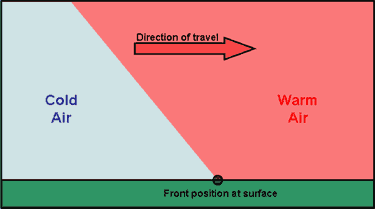
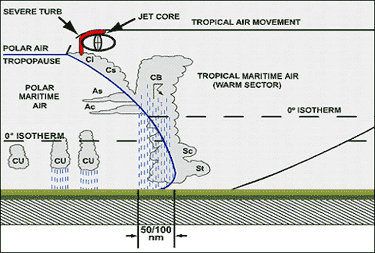
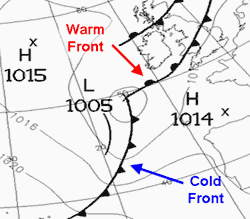
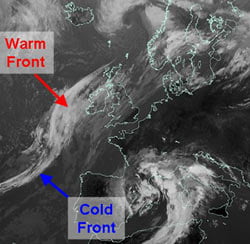
A cold front marks the leading edge of an advancing cold air mass. On a synoptic chart a cold front appear as a blue line with triangles. The direction in which the triangles point is the direction in which the front is moving.

Warm Front

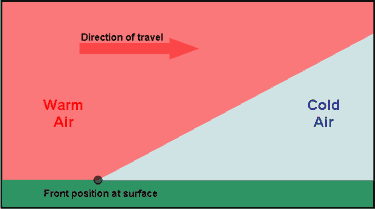
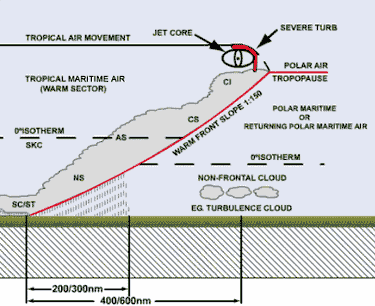
A warm front marks the leading edge of an advancing warm air mass. On a synoptic chart a warm front appears as a red line with semi-circles. The direction in which the semi-circles point is the direction in which the front is moving.

Occlusion (or occluded front)

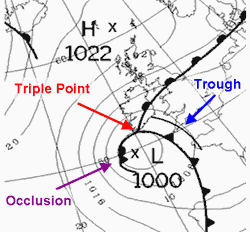
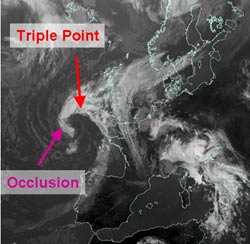
Occlusions form when the cold front of a depression catches up with the warm front, lifting the warm air between the fronts into a narrow wedge above the surface. On a synoptic chart an occluded front appears as a purple line with a combination of triangles and semi-circles. The direction in which the symbols point is the direction in which the front is moving.


Troughs

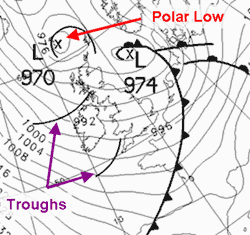
Fronts describe thermal characteristics. They also happen to be where there is significant precipitation. However, precipitation is not confined to fronts. Drizzle in warm sectors or showers in cold air occur fairly randomly, but occasionally, lines of more organised precipitation can develop. These are called troughs.

Isobars

Isobars are lines joining places with equal mean sea-level pressures (MSLP).

Fig 3: Identification of weather systems, isobars and front

Weather systems and fronts

Relationship between isobars and wind

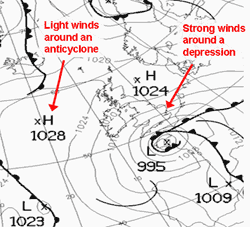
Fig 4: Relationship between isobars and wind speed

Wind is a significant feature of the weather (see Figure 4). A fine, sunny day with light winds can be very pleasant.

Stronger winds can become inconvenient and, in extreme cases, winds can be powerful enough to cause widespread destruction. The wind can easily be assessed when looking at a weather map by remembering that:

  • closer isobars mean stronger winds;
  • the wind blows almost parallel to the isobars;
  • in the northern hemisphere, the wind blows round a depression in an anticlockwise direction and around an anticyclone in a clockwise direction. In the southern hemisphere, the opposite is true;
  • winds around anticyclones can sometimes be even stronger than indicated by the isobars;
  • in warm air, the wind is relatively steady and tends to blow at about two-thirds the speed that the chart would suggest, though there are exceptions to this ;
  • in cold air, the wind is usually as strong as indicated by the isobars and can be very gusty.

Understanding station plots on a weather map

Fig 5: An example of a plotted chart

Good quality observations are one of the basic ‘tools of the trade’ for a weather forecaster.

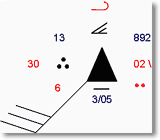
The weather conditions at each individual station can be represented on a surface chart by means of station plot.

This means that information which would take up a lot of space if written on to a chart can be displayed in a quick easy to understand format.

Figure 5 shows an example of a plotted chart.

The land station plot can represent all the elements reported from that station, these typically include:

  • Air temperature
  • Dew-point temperature
  • Wind speed
  • Wind direction
  • Visibility
  • Atmospheric pressure and three-hour tendency
  • Cloud amounts
  • Cloud types
  • Cloud heights
  • Present weather
  • Past weather

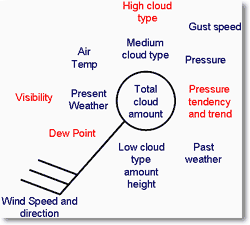
Traditionally station plots for manned observing sites were based around a central station circle. However, increasingly, automatic weather observations are replacing these and being plotted on weather charts. To differentiate between the two, automatic observations are plotted around a station triangle. Each element of the observation, with the exception of wind, is plotted in a fixed position around the station circle or triangle so that individual elements can be easily identified.

Fig 6: Plotting positions on a station circle
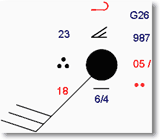
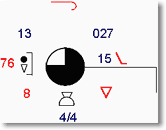
Fig 7: A typical coded manual observation
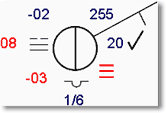
Fig 8: A typical coded automatic observation

Plotting a station plot

Total cloud amount

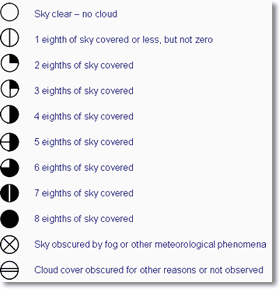
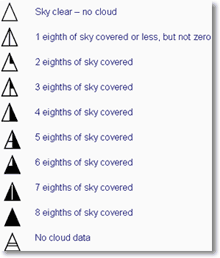
The total amount of the sky covered by cloud is expressed in oktas (eighths) and is plotted within the station circle for manned observations or station triangle for automatic stations, by the amount of shading.

The symbols used for both manual and automatic observations are shown below.

Fig 9: Symbols for manual cloud cover
Fig 10: Symbols for automatic cloud cover

Wind speed and direction

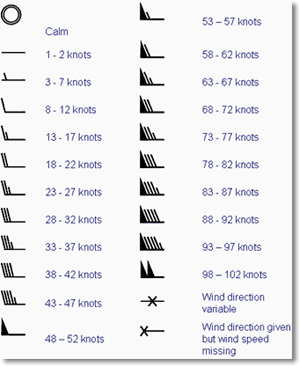
The surface wind direction is indicated on the station plot by an arrow flying with the wind. Direction is measured in degrees from true North. Therefore a wind direction of 180 is blowing from the south. The wind speed is given by the number of ‘feathers’ on the arrow. Half feathers represent 5 knots whilst whole feathers indicate 10 knots. A wind speed of 50 knots is indicated by a triangle. Combinations of these can be used to report wind speed to the nearest 5 knots. The symbols used are as follows.

Fig 11: Symbols for wind speed

Air temperature

Air temperature is plotted to the nearest whole degree Celsius, i.e. 23 would indicate 23 degrees Celsius.

Dew point temperature

Dew point temperature is plotted to the nearest whole degree Celsius, i.e. 18 would indicate a dew point of 18 degrees Celsius.

Pressure

Pressure is recorded in millibars and tenths and the last three digits are plotted. Therefore 1003.1 would be plotted as 031 and 987.1 would be plotted as 871.

Present weather

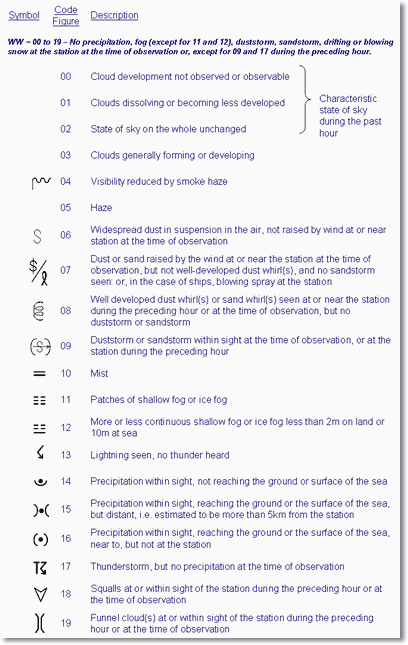
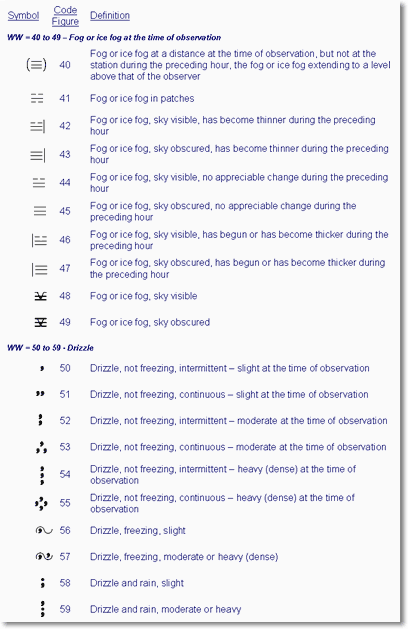
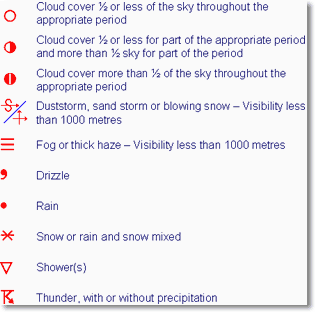
In total the Met Office has 100 codes for recording the current weather at the time of the observation. Different types of weather are represented using different weather symbols, a key to which can be found below.

Fig 12: Symbols for present weather


Fig 13: Symbols for present weather


Fig 14: Symbols for present weather


Fig 15: Symbols for present weather


Fig 16: Symbols for present weather


Past weather

A simplified version of the present weather plots is used to indicate past weather.

Fig 17: Symbols for past weather


Pressure Tendency

Pressure trend shows how the pressure has changed during the past three hours, i.e rising or falling, and pressure tendency shows by how much it has changed. The tendency is given in tenths of a millibar, therefore ’20’ would indicate a change of two millibars in the last three hours. Pressure tendency is indicated by the following symbols.

Fig 18: Symbols for pressure tendency


Visibility

Visibility, which is how far we can see, is given in coded format, in either meters or kilometres. Visibilities below five kilometres are recorded to the nearest 100 metres, whilst those above five kilometres are given to the nearest kilometre.

For visibilities equal to and less than five km:

Fig 22: Example plot
Table 1: Codes for visibilities of less than five kilometres
Code
Distance (km)
Code
Distance (km)
Code
Distance (km)
00
<0.0
19
1.9
38
3.8
01
0.1
20
2.0
39
3.9
02
0.2
21
2.1
40
4.0
03
0.3
22
2.2
41
4.1
04
0.4
23
2.3
42
4.2
05
0.5
24
2.4
43
4.3
06
0.6
25
2.5
44
4.4
07
0.7
26
2.6
45
4.5
08
0.8
27
2.7
46
4.6
09
0.9
28
2.8
47
4.7
10
1.0
29
2.9
48
4.8
11
1.1
30
3.0
49
4.9
12
1.2
31
3.1
50
5.0
13
1.3
32
3.2
51
Not Used
14
1.4
33
3.3
52
Not Used
15
1.5
34
3.4
53
Not Used
16
1.6
35
3.5
54
Not Used
17
1.7
36
3.6
  
18
1.8
37
3.7
  

For visibilities greater than five km:

Table 2: Codes for visibilities of more than five kilometres
Code
Distance (km)
Code
Distance (km)
56
6
73
23
57
7
74
24
58
8
75
25
59
9
76
26
60
10
77
27
61
11
78
28
62
12
79
29
63
13
80
30
64
14
81
35
65
15
82
40
66
16
83
45
67
17
84
50
68
18
85
55
69
19
86
60
70
20
87
65
71
21
88
70
72
22
89
>70

Low cloud type

The type of low cloud present is provided in coded format, using the symbols below.

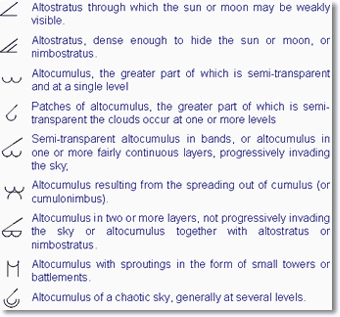
Fig 19: Symbols for low cloud type

Medium cloud type

The type of medium cloud present is provided in coded format, using the symbols below.

Fig 20: Symbols for medium cloud type

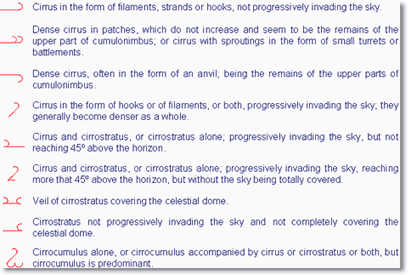
High cloud type

The type of high cloud present is provided in coded format, using the symbols below.

Fig 21: symbols for high cloud type

Cloud height

Cloud heights are measured in hundreds or thousands of feet. The way these are plotted varies depending on whether the station is an automatic or manned observing site.
For automatic stations, indicated by a station triangle, the following codes are used.

Table 3: Cloud heights for automatic stations
Code
Height in feet
00
<100
05
500
10
1000
15
1500
20
2000
50
5000
60
6000

For manned stations, indicated by a station circle, the following codes are used.

Table 4: Cloud heights for manned stations
Code
Height in feet
0
0-149
1
150-299
2
300-599
3
600-999
4
1,000-1,999
5
2,000-2,999
6
3,000-4,999
7
5,000-6,499
8
6,500-7,999
9
8,000 or above
/
Cloud height unknown

Gust speed

Gust speeds are measured in knots and proceeded by the letter G. Gust speeds are normally only recorded if they exceed 25 knots and are plotted as whole knots, i.e. G35 indicates a gust of 35 knots.

Example

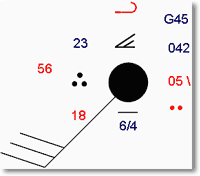
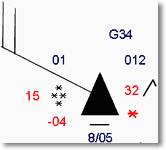
The decode of this station plot is as follows:

Fig 22: Example plot
Type of observation:
Manned
Total cloud amount:
8 oktas
Wind Speed:
28-32 knots
Wind direction:
South-westerly
Air temperature:
23 degrees Celsius
Dew point temperature:
18 degrees Celsius
Pressure:
1004.2 millibars
Present weather:
Continuous moderate rain
Past weather:
Rain
Pressure tendency:
Falling 0.5 millibars in the past three hours
Visibility:
6km
Low cloud type:
Stratus
Low cloud amount:
6 oktas
Low cloud height:
1000 feet
Medium cloud type:
Altostratus
High cloud type:
Cirrus
Gust speed:
45 knots


Exercise

Why not try decoding the following observational plots.


Web page reproduced with the kind permission of the Met Office

Interpreting Isotherms

Isotherms

The figure below is a map of isotherms, showing the average mean temperatures for January over the UK, based on average values for 1961–90.

1. Explain the reasons why Newquay is warmer than Ayr in January.

2. With reference to the Environmental Lapse Rate, outline why temperatures at Okehampton are lower than at Newquay.

3. In northern England, temperatures on the west coast near Keswick are similar to those at Middlesbrough on the east coast. Explain how the föhn effect might influence these temperature patterns.
4. (a) Outline how physical factors affect the shape of the 4 °C isotherm in the River Severn estuary and valley north of Gloucester.
    (b) How does this pattern affect agriculture?

5. The 4 °C isotherm also bulges around cities such as London and Bristol. Explain the human factors which have caused these cities to be milder in January than rural areas with a similar latitude, such as Marlborough.

isotherms

Web page reproduced with the kind permission of the Met Office.


UK Climate

Contents 

1. Introduction
1.1 What is climate?
1.2 Climate overview – the British Isles
1.3 Latitude
1.4 Position relative to continents and oceans
1.5 Position relative to large-scale atmospheric circulation patterns
1.6 Altitude
1.7 Local geographic features

2. Main characteristics of the British climate
2.1 Temperature
2.2 Precipitation
2.3 Wind
2.4 Sunshine
2.5 Visibility

3. Regional climate of the UK
3.1 England
3.2 Scotland
3.3 Wales
3.4 Northern Ireland

4. Additional UK climate information

5. Questions

1. Introduction

This unit explains what is meant by the term ‘climate’ and outlines the factors that govern the climate of the British Isles.

1.1 What is climate?

According to The Meteorological Glossary, published by the Met Office, ‘climate’ is defined as ‘the synthesis of the day-to-day values of the meteorological elements that affect its locality’.

‘Synthesis’ here means more than simple averages as the climate also involves extreme values, and the ranges within which phenomena occur, and the frequencies of weather types with associated values of elements.

The main climatic elements are precipitation, temperature, humidity, sunshine, wind velocity, and phenomena such as fog, frost, thunder, gale. Cloudiness, grass minimum temperature, and soil temperature at various depths may also be included in a climatic description of any area.

Climatic data are usually expressed in terms of an individual calendar month or season and are determined over a period of about 30 years. This is long enough to ensure that representative values for the month or season are obtained and freaks or abnormal values do not exert too strong an influence. The study of the values and frequencies of the meteorological quantities is known as climatology.

The climate of a locality is mainly governed by the factors of:

(i) latitude;
(ii) location, relative to continents and oceans;
(iii) situation in relation to large-scale atmospheric circulation patterns;
(iv) altitude;
(v) local geographical features, such as topography or the nature of the built-up area.

1.2 Climate overview – the British Isles

The British Isles have a unique climate – so much so, that a popular exam question of the past is ‘Britain does not have a climate, it only has weather: discuss’.

Such a statement has been made because weather conditions can vary so much from day to day, as well as from season to season. Having said this, Britain generally has cool summers and relatively mild winters. Whilst there are parts of the world with similar summers or similar winters, there is nowhere in the world with the same summers and winters as ours. The South Island of New Zealand and Tasmania, for example, have similar summers to ours, but their winters are milder chiefly because they are nearer the equator.

The British Isles are small compared with the other land masses in the northern hemisphere – hence they are more influenced by the ocean compared with other European countries, and the Gulf Stream helps to keep winters milder compared with other landlocked nations with a similar latitude.

The latitude of the British Isles means that they are influenced by predominantly westerly winds with depressions and their associated fronts (bands of cloud and rain), moving to the east or north-east across the North Atlantic, from the eastern coast of North America, bringing with them unsettled and windy weather, particularly in winter.

Between these depressions, there are often small mobile anticyclones that bring a period of fair weather. Sometimes large, stationary anticyclones become established near the British Isles where they effectively act as a ‘block’ to the regular passage of the depressions. These larger anticyclones can often last for over a month, and completely change the character of the weather. In winter, these blocking anticyclones bring dry weather, but with the cooling at night the drop in temperatures results in fog, which can be reluctant to clear the following day when the weak sunshine is unable to raise the temperature. If one of these anticyclones becomes positioned to north of the British Isles, often they become established over Scandinavia, and easterly winds on their southern side draw very cold air from the continent of Europe.

During the summer, these blocking anticyclones can lead to drought conditions, as rain-bearing fronts are ‘diverted’ around the country. Such a situation occurred in 1976 when a high-pressure cell sat over the UK for much of the summer, causing a noticeable drop in precipitation, well below the normal average.

There are many regional variations and microclimates in the British Isles, ranging from the nearly subtropical climate of Cornwall, to the dry semi-arid conditions of East Anglia to the Arctic tundra conditions which can be experienced in the highlands of Scotland. The western and northern parts of the British Isles tend to lie close to the normal path of the Atlantic depressions, giving mild and stormy winters and cool and windy summers when the depressions track a little further north. These areas also have the highest land, and the upland barriers have the effect of producing significant increases in rainfall. The lowland, mainly on the eastern side, has a similar climate, but less severe winters.

There are also other regional variations: the south is warmer than the north, while the west is wetter than the east. In general, the more extreme weather tends to occur in the mountainous and hilly areas where it is often cloudy, wet and windy.

It is possible to analyse the climate of the British Isles in more detail by considering the main factors governing the climate of a locality, as listed in 1.1.

1.3 Latitude

The British Isles have a latitude between 50° N and 60° N. At this latitude, the length of daylight has a significant variation between summer and winter. For example in mid-December the period between sunrise and sunset in London is 7 hours and 50 minutes, while in Lerwick, Shetland, it is 5 hours and 50 minutes; in mid June it is 16 hours and 40 minutes in London and 18 hours 50 minutes in Lerwick.

Latitude not only affects the amount of solar radiation that reaches the British Isles by hours of daylight but also the area over which a given amount of solar radiation is acting. This variation in solar radiation and length of day gives the British Isles distinct seasons.

Given this mid-latitude position, the British Isles are influenced by predominantly westerly winds, and low-pressure systems with their weather fronts (bands of cloud and rain) move generally east or north-east across the North Atlantic from North America. The conditions these low pressure systems bring are generally unsettled with periods of wet and windy weather. As the British Isles lie to the west of mainland Europe, they are often the first landfall reached by the moisture-laden depressions. Thus the majority of the rain falls over the British Isles, and the fronts are usually considerably weaker by the time they reach the mainland of continental Europe.

The sequence of low-pressure systems is often punctuated by ridges of high pressure. These can bring periods of fine weather, and the net result is that the weather is noticeably changeable.

1.4 Position relative to continents and oceans

Another important factor influencing the weather of the British Isles is their position close to the ocean, rather than being in the centre of a large land mass. This is clear when comparing the climate of London and Moscow. The latter has a similar latitude to London, but London has cooler summers and milder winters. This is because Moscow is situated away from the warming effects of the Gulf Stream and other warm ocean currents that could keep the winter temperatures mild.

There is a reversal during the summer, when these ocean currents help to keep London’s temperatures lower than Moscow’s. This is because water has a higher specific heat than land, and in the summer, Moscow is warmer, chiefly because of its location within an extensive continental land mass.

Another factor is the influence of airstreams. Those reaching the British Isles originate in very warm or cold regions. However, by the time they reach us they have often had their temperature greatly modified. If the wind is predominantly westerly the air is modified by the ocean (warm Gulf Stream) and the fronts are brought in from the Atlantic. This modification by the ocean means that we experience cool summer weather or mild winter weather.

1.5 Position relative to large-scale atmospheric circulation patterns

A third influence affecting the climate of the British Isles is the location relative to the large-scale atmospheric circulation systems that are part of the tri-cellular model.

The western and northern parts of the British Isles tend to be close to the normal path of Atlantic low-pressure systems or depressions. As a result, these areas tend to be mild and stormy in winter, and in the summer, when depressions take a more northerly route and are less deep, cool and windy.

The boundary of these large-scale pressure systems varies over time, allowing a blocking anticyclone to become established. They can draw air from the continent rather than the Atlantic, giving us summer heatwave conditions or very cold winter conditions.

1.6 Altitude

Many meteorological factors vary with increasing (or decreasing) altitude. In general, wind speed increases with height, with the strongest winds being experienced over the summits of hills and mountains.

In contrast, temperatures decrease with altitude, with the average (environmental lapse rate) change being 0.65 °C per 100 metres. However, the rate of cooling varies depending on the moisture (water vapour) content of the air. Moist air rises and cools at the saturated adiabatic lapse rate of 0.5 °C per 100 metres, whilst dry air rises and cools at the dry adiabatic lapse rate of 0.98 °C per 100 metres.

Precipitation can increase with altitude as a result of relief, or orographic, rainfall. The upland barriers force up the air masses, causing them to cool, so that water vapour condenses, allowing raindrops to form and fall near the summit, or on the windward slopes. This explains why upland areas such as the Lake District, have average annual rainfall totals exceeding 2,000 mm.

Sometimes, the air temperature cools so much that snow is produced. It is comparatively rare near sea level in England, but much more frequent over hills, thus the average number of days when snow falls in England varies from 10 or less in the south-western coastal areas to over 50 in the Pennines.

1.7 Local geographic features

Local geographic features have an effect on the local climate. These features include hills and valleys, forests and plains, lakes and rivers, as well as urban and rural locations.

Hills and valleys can experience very different climates from the regional weather conditions. The temperature at night becomes lower in the valleys than on the surrounding hills. During the night and during the winter months, cold air flows down into the bottoms of the valleys because of its greater weight. Thus, in the valley areas, the generally lower temperatures increase the risk and the frequency of fog. During the day in summer, the valley gets higher daytime temperatures than the hills. The winds are stronger on the hills than in the valleys.

In long valleys, the winds can only blow along the line of the valley. Places in the lee of hills or mountains get less precipitation than places on the windward side. This is known as a rain shadow. In winter months high temperatures can occur in the lee of high ground. These high temperatures (up to 16°C on rare occasions) occur when a moist south to south-westerly airflow warms up downwind of mountains, an effect known as the Föhn after its more dramatic effect in the Alps.

As far as forests and plains are concerned, summer temperatures are usually lower in the forest areas than over a plain whilst in the winter the opposite is generally true. This is because the forests can store large amounts of heat, whilst the plains react quicker to incoming and outgoing radiation. The surface of a forested area is rougher, reducing wind speed compared to the higher winds over a smoother plain. Trees extract large amounts of groundwater and store large amounts of water that is given off to the atmosphere. Hence, humidity increases over woods while there is strong evaporation over plains.

Trees are used in a number of ways to modify the local climate. They are planted as shelter or windbreaks. As shelter breaks, they reduce the effect of the wind and raise the temperature. They are also planted to reduce wind erosion which helps the growth of crops. In some desert areas, this has been well developed near oases where a shelter belt is planted as outer protection to reduce the effect of the sandstorms and to stabilise the sand. Within this protective boundary, date palms are planted which, in turn, provide shade for other cropping trees that, in turn, shade crops beneath them.

Proximity to water also has a marked affect on microclimate, in the same way that the sea affects the macroclimate of the British Isles. Locations near to lakes and major rivers generally have milder winters and cooler summers.

There are also noticeable contrasts between urban and rural areas. Urban areas have minimum temperatures which are higher than those recorded in the rural areas, whilst cities can also have higher maximum temperatures. These effects are known as the urban heat island, and are caused by firstly, the materials used in buildings storing and then releasing heat, and secondly by the release of heat due to industrial and domestic energy consumption. Convectional rainfall and smogs can often occur more regularly in urban areas.

2. The main characteristics of the British climate

This session aims to look at the main characteristics of the climate of the British Isles. In general terms, the climate of the British Isles can be summarised as follows.

Temperature: the south is warmer than the north.

Precipitation: the west and north-west, and more specifically the mountains in these areas are wetter than the lowlands of the east.

Wind: the north and west is in general windier than the south and east, but it is less windy inland than on the coasts, and less windy in low-lying areas than on the tops of hills and mountains.

2.1 Temperature

Air temperature varies on a daily (diurnal), seasonal and geographical basis. On a daily basis, the temperature is usually lower at night, when there is no incoming solar radiation, and the energy is being released back into space. Thus the coldest nights are those on which there is little wind, and there is a covering of snow on the ground, creating a high albedo effect. The lowest temperatures occur inland, away from the moderating influence of the relatively warmer sea.

January is usually the coldest time of the year. The least-cold areas are the south-west of England and the Channel Islands whilst the coldest areas are the Grampian and Tayside regions of Scotland. The main factor in determining this distribution of winter temperature is the proximity of the coast, particularly the west coast, and the warming Gulf Stream.

Minimum temperature normally occurs shortly after dawn and the maximum temperature two to three hours after midday. In the urban areas, the minimum temperatures experienced tend not to be so low as those recorded in rural areas although maximum temperatures are often higher. Some sheltered and low-lying areas have a greater incidence of frosts, and more severe frosts, than the surrounding areas. These are known as frost hollows.

July is normally the warmest month and the highest temperatures occur inland in central areas, furthest away from the cooling influence of the sea. The higher specific heat of sea water renders it slow to heat up, but equally reluctant to cool down. These differences affect the climate in a number of ways. Firstly, the sea can warm, by the exchange of sensible and latent heat, the air flowing over it therefore making parts of the British Isles warmer. It can, of course, happen the other way, when the sea is cooler than the land, the wind from the sea is cooler. This explains why sea-surface temperatures reach their lowest values in late February or early March. Thus, around the coasts, February may be the coldest month, although there may be little to choose between January and February.

Localised heating can also take place depending on the nature of the environment. Urban areas can heat up differently to, and more quickly than, rural areas to produce their own urban heat island. It is not uncommon for the forecast minimum temperature for London to be at least 2 or 3 degrees higher than the surrounding comparatively rural locations.

On a larger scale, temperature differences can occur as a result of periodic fluctuations in sea-surface temperatures in the Atlantic Ocean. These are smaller in scale compared with the El Niño Southern Oscillation (ENSO) in the central Pacific. Even so, they are still important as far as temperatures in Britain are concerned.

The sea-surface temperature changes in the Atlantic are known as the North Atlantic Oscillation (NAO), and they are governed by the behaviour of the Azores high pressure and the sub-polar low pressure zones. The pressure gradient between the two zones helps to define the zone within which the mid-latitude westerly circulation occurs.

When air pressure is unusually low over Iceland and high over the Azores – thus a very steep pressure gradient – the NAO is said to be positive. When both pressure areas are not significantly or poorly developed, that is the pressure gradient is weak, the NAO is negative. In positive mode, the westerlies are strengthened so that warm air and water are advected towards the British Isles.

The mild winters of the 1980s and early 1990s in Britain were a time of significantly positive NAO. In the negative phase, the Icelandic low becomes displaced south-westwards, and a blocking situation develops around the British Isles with the polar high pressure penetrating southwards. The exceptionally cold winters of 1962/63 and 1941/42 are examples of this negative phase.

The British Isles have the longest instrumental record of temperature for any region of the world, known as the Central England Temperature series which extends back to 1659. Temperatures over the British Isles have risen by about 0.7 °C since 1700 and by about 0.5 °C since the start of the 20th century.

2.2 Precipitation

Precipitation has been recorded in the British Isles for over 200 years. Through the dedication and enthusiasm of W R Symons, the mid-19th century saw the formation of the British Rainfall Organisation whose main objective was to establish a countrywide network of rain gauges where daily measurements were made. This network has grown to over 7,000 gauges today, including many that are automatic.

As most people in the British Isles know, precipitation can be extremely variable, both in intensity and duration. The spatial distribution of precipitation during an individual month is very uneven, just as it is on an individual day. Rainfall in Britain is associated with several distinct synoptic situations; all places may get rain from most such types, but some areas get more from some types than others. Therefore, it is not surprising that patterns of temporal variation of rainfall are complex.

Precipitation over the British Isles is the result of one or more, of three basic mechanisms.

1. Cyclonic, or frontal, rain associated with the passage of low-pressure systems. Bands of rain are associated with the passage of warm and cold fronts across the UK. These rain events are caused by the uplift and cooling of moist air parcels.

2. Convectional, with local showers and thunderstorms, caused by the localised thermal heating and overheating of the ground surface. Large towering cumulonimbus clouds may be generated, producing heavy rain.

3. Orographic, or relief rain, with precipitation increasing with altitude over upland areas. The mechanism for relief rain is the uplift and cooling of moist air over upland areas. The normal rate of cooling (environmental lapse rate) is 6.5°C per 1,000 metres. Therefore, near the summit on the windward side of the hill or mountain, the air will have cooled sufficiently for thick cloud, rain and possibly snow to fall.

Air will descend and warm on the leeward side, so there is little or no rain on this leeward side of the hill or mountain. This is called a rain shadow, and sometimes there are warm winds in these sheltered areas as the air, now much drier than during its ascent, descends quickly and warms up. This is called a Föhn effect, and the warm winds are called Föhn winds.

2.3 Wind

Winds over the British Isles can be a resource and a hazard. Hundreds of wind turbines have been installed in exposed parts of the British Isles, adding extra megawatts of electricity to the National Grid, and exploiting this wind resource.

However, severe storms can be a hazard, causing extensive damage to commercial and domestic property, as well as laying bare areas of woodland. The severe storm on 16 October 1987 cost the insurance industry around £1.2 billion, and 15 million trees were uprooted. On Burns’ Day, 25 January 1990, another deep low pressure system swept across the country, with speeds of 107 m.p.h. recorded at Aberporth in Ceredigion and 98 m.p.h. at Herstmonceux in Sussex.

The windiest parts of the British Isles are those on the north-west and south-west coasts, and in exposed upland areas. These are the locations across which mature depressions usually pass, and on 7 February 1969, Kirkwall in the Orkney Islands recorded a gust of 136 m.p.h. as an extremely deep and vigorous depression developed.

Coastal areas bear the brunt of gales from the Atlantic, especially during the winter when the low pressure cells are particularly active and well developed. These gales can pose extreme hazards for fishermen and sailors, and during the ‘Great Storm of 1703’ on 26 and 27 November, hundreds of ships in the English Channel and North Sea were destroyed, and an estimated 8,000 people were killed.

There are local variations with warm and cool sea breezes, plus valley winds and Föhn winds in the lee of upland areas. The sea breezes can create diurnal variations, with higher wind speeds in the afternoon, due to heating from the ground. Urban areas, especially those with tall skyscrapers and an irregular skyline, can also be windier than the surrounding suburbs and rural areas as the buildings disturb the local airflows and create turbulence.

2.4 Sunshine

Mean daily sunshine figures reach a maximum in May or June and are at their lowest in December. The key factor, of course, is the length of day throughout the year, but wind and cloud play their part as well.

2.5 Visibility

Visibility means the distance at which the outlines of a building can be seen in daytime, or at night, at which ordinary house lights can be discerned. Before the First World War, the custom was to use terms such as haze, mist, or fog in referring indirectly to atmospheric visibility. Qualitative descriptions such as exceptional visibility were also used. These terms were not very precisely defined.

The First World War and the years that followed saw the development of aviation that required more-precise information and this led to the development of numerical observations for visibility. In places where visibility observations are made it has been the practice to maintain a list of permanent objects. Measuring equipment such as the Gold visibility meter and the transmissometer have also been developed for measuring visibility and their use has become more common, from airfields to motorways and ports, as well as stations recording meteorological data. Visibility variation also depends to some extent on the colour and illumination of an object being observed against its background, as well as the optical vision of the observer!

Visibility is, broadly speaking, related to the concentrations of water droplets or solid particles. Conditions favouring a decrease or an increase of these constituents in the atmosphere will lead to an improvement or deterioration of visibility. When water droplets are present in suitable concentration and sizes, mist or droplet fog may be formed. The occurrence of fog is usually associated with radiation cooling or advection cooling, so that air temperatures fall below dew point.

3. Regional climate of the UK

This section looks at the different climates in each region of the UK. The notes below highlight the importance of local features in producing subtle variations.

3.1 England

Temperature – over England the mean annual temperature at low altitudes varies from 8.5 °C to 11 °C, with the highest values occurring around or near the coast of Cornwall. The mean annual temperature decreases by approximately 0.5 °C for each 100 metres increase in height so that for example, Great Dun Fell in Cumbria (at 857 m) has an annual mean temperature of 4 °C.

Winter temperatures in the British Isles are influenced by the thermal characteristics of the surrounding sea. They reach their lowest values in February or early March, so in coastal areas, February is normally the coldest month. Inland, away from the influence of the sea, the coldest period occurs a little earlier and January and February are the coldest months. Indeed, it was in an inland valley that the lowest temperature recorded in England was made – at Newport in Shropshire on 10 January 1982, -26.1°C. As a comparison, the coldest temperature ever recorded in Plymouth in Devon was -8.8°C on 2 January 1979.

July is normally the warmest month in England. Again, the extreme temperatures occur inland, away from the influence of the sea. The UK record temperature of 37.1°C at Cheltenham on 3 August 1990, was beaten by a number of stations on 10 August 2003, with Brogdale near Faversham in Kent, reporting the highest at 38.5 °C.

Precipitation

Rainfall

Fig 1: Monthly averages (1961-90) of rainfall (mm) for a selection of stations in England.

The Lake District is the wettest part of England, with annual totals exceeding 2,000 mm, comparable to the Highlands of Scotland. The Pennines and the moors of south-west England are almost as wet. Conversely, all of East Anglia and much of the Midlands, eastern and north-eastern England, as well as parts of the south-east experience less than 700 mm in a year.

The typical occurrence for rain is about one day in three in England, especially in winter, rather than in summer, although in most years, there are likely to be long dry spells.

Near the south coast there is an appreciable summer minimum and winter maximum of rainfall, with totals in July about half those in January. The western, northern and eastern coasts are likely to see the driest month in spring and the wettest month in late autumn. It can be a different situation in inland areas, with parts of the Midlands experiencing a summer rainfall maximum. This reflects the higher frequency of thunderstorms (convectional rain) in the more central and south-eastern parts of England. For example thunder occurs on average 15 days per year in London and Birmingham, but in the west and north-west the frequency declines to around eight days per year.

The maximum rainfall recorded in one day was 279 mm at Martinstown (Dorset) on 18 July 1955.

Snow

Fig 2: 30-year (1961-90) average number of days in month with snow lying at 0900 hours at selected stations.

Snow is comparatively rare near sea level in England, but is much more frequent over hills. The average number of days each year when sleet or snow falls in England varies from about 10 or less in some south-western coastal areas to over 50 in the Pennines. Snow rarely lies on the ground at sea level before December or after March and the average number of days with snow lying in England varies from five or less around the coasts to over 90 in parts of the Pennines.

The number of days of snowfall and snow cover varies enormously from year to year. At many places in England in the last 50 years, it has ranged from none at all in a number of winters, to in excess of 30 days during the winters of 1946/47 and 1962/63. Even places near the coast experienced prolonged snow cover during these two winters, especially over higher ground, resulting in severe disruption to transport. Fortunately, such prolonged spells of winter snowfalls are comparatively rare.

Wind

Fig 3: Monthly average number of days (1961–90) with gales at selected stations.

The strongest winds in the United Kingdom are associated with the passage of deep depressions across or close to the British Isles. These are most frequent during winter, when the depressions are most active over the open ocean. The western coasts are most exposed to the stronger winds at low altitudes, with Ireland affording protection to much of England. The most exposed areas are the coasts of Devon and Cornwall where there are about 15 days of gale a year. Inland the number of days of gale decreases to fewer than five days a year.

The highest gust recorded at a low-level site, was 103 knots (118 m.p.h.) at Gwennap Head, Cornwall, on 15 December 1979.

Sunshine

Fig 4: 30-year (1961-1990) average monthly duration of bright sunshine in hours for selected stations.

On sunny days in summer, the formation of convective (cumulus) cloud takes place over land, whilst skies over the sea remain cloud-free. Therefore, the sunniest parts of England (and the whole of the British Isles) are along the south coast of England. Many places along this coast achieve annual average figures of around 1,750 hours of sunshine. The maximum duration in one month of bright sunshine is 383.9 hours at Eastbourne, East Sussex, in July 1911.

The dullest parts of England are the mountainous areas with annual average totals of less than 1,000 hours. The minimum duration in a month, was zero hours, recorded at Westminster, Greater London, December 1890.

Visibility – many parts of England, especially those remote from industrial and urban areas, enjoy good visibility. This is particularly true of most coastal areas, the mountains and the moorlands.

Over high ground in England, hill fog can be both extensive and frequent , and it is a potential hazard to be borne in mind by walkers. Indeed, Great Dun Fell (857 metres) in Cumbria had an average of 233 days of fog per year between 1963 and 1976.

3.2 Scotland

Temperature: over Scotland the mean annual temperature at low altitude ranges from about 7 °C in the Shetland Islands, in the far north, to 9 °C on the coasts of Ayrshire and Dumfries and Galloway in the south-west. Due to the environmental lapse rate, there is a temperature decrease of about 0.6 °C for each 100 m rise in height, and as a result the temperatures over higher ground are generally colder. For example, Braemar (at 339 m above mean sea level) has an annual mean temperature of 6.4 °C while the corresponding value on Ben Nevis (altitude 1,344 m ) is 0.3 °C.

In common with other parts of the British Isles, winter temperatures are influenced by the surrounding areas of sea. The North Sea is cooler than the waters off the west coast, so the east coast of Scotland is generally cooler than the west coast. In general, January and February are the coldest months when the daytime maximum temperatures over low ground average around 5-7 °C. On rare occasions in the lee of high ground, a föhn effect can cause temperatures to reach around 15 °C. The lowest temperatures occur inland away from the moderating influence of the sea, and in valleys into which cold air sinks. In these conditions, the temperature dropped to -27.2 °C at Braemar on 10 January 1982 and more recently at Altnaharra on 30 December 1995. (This is the lowest temperature ever recorded in the British Isles.) In coastal areas, such cold nights are not experienced and as an example, the lowest temperature recorded at Lerwick in the Shetland Islands in the 30 years between 1961 and 1990 is only -9°C.

In summer, the more northerly latitude of Scotland explains the drop in the amount of solar radiation. Thus, the temperatures in Scotland are on average a few degrees cooler than in England. For example, in July the average daily maximum temperature at Glasgow is 19 °C compared with London 22 °C. July and August are normally the warmest months in Scotland. As the sea has a cooling influence on coastal areas, the highest temperatures occur inland. The highest temperature recorded in Scotland was 32.9 °C at Greycrook (Scottish Borders) on 9 August 2003, beating the previous Scottish record of 32.8 °C at Dumfries on 2 July 1908 and on several occasions at other places in the 19th century.

Precipitation

Rainfall

Fig 5: Monthly averages (1961-90) of rainfall (mm) for a selection of stations in Scotland.

There is a misconception that the whole of Scotland experiences high rainfall. In fact, rainfall in Scotland varies widely, with a distribution closely related to the topography, ranging from over 3,000 mm per year in the western Highlands (similar to the total rainfall experienced in the mountains of the Lake District in England and Snowdonia in Wales) to under 800 mm per year near the east coast (comparable with the Midlands of England).

The frequency of thunderstorms in Scotland is around three to nine days per year. This is relatively low compared with an average of 9-15 days per year over England. The number of thunderstorms can vary widely from year to year, but in general the northern and eastern coasts of Scotland average only three or four days with thunder per year, whilst inland values range from nine in the south to six in the north.

Snow

Fig 6: 30-year (1961-90) average number of days in month with snow lying at 0900 hours at selected stations.

Temperatures generally decrease with height, so precipitation falling to the ground as rain at low-level sites may fall as snow over higher ground. Consequently, there is a marked increase with altitude in the number of days with falling snow and also in the number of days with snow lying on the ground.

The average number of days with sleet or snow falling in Scotland ranges from 20 or less near the west coast to over 100 days in the Cairngorm Mountains and some other high peaks. Snow rarely lies on the ground at sea level before November or after April. On low ground in the Western Isles and in most coastal areas of Scotland, snow lies on an average for less than 10 days per year, although this increases to around 15-25 days for coasts in the north and north-east. However, over the mountains, snow typically lies for more than 50 days per year.

In heavy snow, there can be quite extensive drifting, especially over higher ground. Snow deposited in natural hollows, such as high-level corries, can persist for some considerable time, an effect utilised to good effect by the development of the skiing industry in Scotland, and a few of these high level, north-facing, snow beds are semi-permanent, only disappearing in very occasional summers. On the highest summits, such as Ben Nevis, snow cover typically persists for around six or seven months of the year.

Winds

Fig 7: Monthly average number of days (1961-90) with gales in selected stations.

The most common direction from which the wind blows in Scotland is from the south-west, but the wind direction often changes markedly from day to day with the passage of weather systems. There is a close relationship between surface isobars and the wind speed and direction over open, level terrain. However, in mountainous areas local topography also has a significant effect, with winds tending to blow along well defined valleys.

Since many major Atlantic depressions pass close to or over Scotland, the frequency of strong winds or gales is higher than in other parts of the British Isles. Over low ground the windiest areas are the Western Isles, the north-west coast and the Orkney and Shetland Islands with over 30 days with gales per year in some places.

Sunshine

Fig 8: 30-year (1961-90) average monthly duration of bright sunshine in hours for selected stations.

Generally, Scotland is more cloudy than England, due mainly to the hilly nature of the terrain and the proximity of low-pressure systems from the Atlantic. Despite this, parts of Angus, Fife, the Lothians, Ayrshire and Dumfries and Galloway average over 1,400 hours sunshine per year. This compares favourably with coastal areas of Northern Ireland and the north of England, but is less than the annual totals of over 1,700 hours experienced along the south coast of England. The dullest parts of Scotland are the more mountainous areas, with an annual average of less than 1,100 hours of sunshine over the mountains of Highland Region. Mean daily sunshine figures reach a maximum in May or June and are at their lowest in December. Wind and cloud play their part but the key factor is day length throughout the year due to the relatively high latitude of Scotland.

Visibility â€“ Scotland often enjoys excellent visibility, largely because of its remoteness from the industrial and urban areas of Britain and mainland Europe. In the industrial areas of central Scotland the switch away from coal fires and the decline in traditional heavy industry has reduced the incidence of smoke haze caused by local air pollution. However, cloud with a very low base can often shroud high ground with hill fog. Extensive hill fog often develops, especially in the west, when a moisture-laden south-westerly airstream covers the country. The resulting low visibility and drizzle, can pose a hazard for hill walkers and motorists.

Radiation fog may form overnight in low-lying inland areas on clear, calm nights, particularly in winter. Sea fog formed by advection cooling can develop over the North Sea. Known locally as Haar, it sometimes ruins what would otherwise be a fine day on or near the east coast, or in the Northern Isles, between April and September. Both these types of fog tend to break up and disperse during daytime, although inland, during the winter, mist and fog does sometimes persist. At Edinburgh, the midday visibility is less than 1,000 m on 3% of December days.

3.3 Wales

Temperature – Over Wales, the mean annual temperature at low altitude varies from about 9.5 °C to 10.5 °C, with higher values occurring around or near the coasts. The mean annual temperature decreases with the environmental lapse rate, by approximately 0.5 °C for each 100 m increase in height, so that for example Bwlchgwyn, Wrexham, at 386 m, has an annual mean temperature of 7.3 °C. On this basis, Snowdon at 1,085 m would have an annual mean temperature of about 5 °C.

In winter the coldest areas are away from the coasts, where the sea has little influence on temperature. Cold air drains into the floors of inland valleys, and it is here that the lowest temperatures are found. Indeed, it was under such conditions that the lowest recorded temperature in Wales has been recorded, -23.3 °C at Rhyader on 21 January 1940.

Coastal areas do not experience such cold nights, for example the lowest temperature recorded at Brawdy in Pembrokeshire was -10.7 °C on 13 January 1987. On the opposite extreme some of the highest winter temperatures recorded in the British Isles have occurred in Wales up to 18 °C. These occur when a powerful Föhn effect develops downwind of Snowdonia in a moist south to south-easterly airflow.

July is normally the warmest month in Wales, with the highest temperatures occurring away from the cooling influence of the sea. The highest temperature recorded in Wales was 35.2 °C at Hawarden Bridge in Flintshire on 2 August 1990.

Precipitation

Rainfall

Fig 9: Monthly averages (1961-90) of rainfall (mm) for a selection of stations in Wales.

Rainfall in Wales varies widely, with the highest average annual totals being recorded in the mountainous areas of Snowdonia, with the wettest parts having over 3,000 mm per year, and the Brecon Beacons, where the yearly fall is comparable to the English Lake District or the Western Highlands of Scotland. In the east, close to the border with England, annual totals are similar to those over much of the English Midlands (around 1,000 mm per year), whilst similar totals are also found in the coastal areas.

Throughout Wales, the months of October to January are significantly wetter than those from February to September, unlike places in south-east Scotland and the English Midlands where July and August are often the wettest months of the year. This is a reflection of the relatively low frequency of thunderstorms in Wales compared with England. For example at Cardiff, thunder occurs on an average of 11 days a year, compared with 15-20 in many places in England. In the west and north-west, the frequency declines to around eight days per year.

Snow

Fig 10: 30-year (1961-90) average number of days in month with snow lying at 0900 hours at selected stations.

Snow is comparatively rare near sea level in Wales but much more frequent over the hills. The average number of days each year when sleet or snow falls in Wales varies from about 10 or less in some south-western coastal areas to over 40 in Snowdonia. Snow rarely lies on the ground near sea level before December or after March, and the average number of days with snow lying in Wales varies from six or less around the coasts to over 30 in Snowdonia.

The number of days of snowfall and snow cover varies enormously from year to year. At many places in the last 50 years, it has ranged from none at all in several winters, to in excess of 30 days during the Winters of 1946/47 and 1962/63. Even places near the coast experienced prolonged snow cover during these two winters.

In heavy snowfalls there can be quite extensive drifting of snow in strong winds, especially over higher ground, resulting in severe dislocation of transport. Fortunately, such occasions are rare, but one of the worst snowstorms in the 20th century in South Wales occurred on 7 and 8 January 1982, when depths of one metre or more were commonplace, with severe drifting and power lines brought down.

Winds

Fig 11: Monthly average number of days (1961-90) with gales in selected stations.

The strongest winds in the British Isles are associated with the passage of deep depressions across or close to the country. These are most frequent in winter and it is then that gales are most frequent. As these depressions are most intense over the open Atlantic Ocean, low-lying parts of Wales have more-frequent gales. For example, in the extreme south-west of Dyfed about 30 days of gales occur on average per year. Further north, Wales is more protected by Ireland. Other coastal areas have 15 days or more of gale with the number of days decreasing to five days or fewer inland.

In general, wind speed increases with height, with strongest winds being observed over the summits of hills and mountains. There are no wind recording stations at high altitudes in Wales, so no data can be given but, as an indication, Snaefell on the nearby Isle of Man (at 615 metres) has, on average, over 200 days of gales a year.

Sunshine

Fig 12: 30-year (1961-90) average monthly duration of bright sunshine in hours for selected stations.

Wales is generally cloudier than England as a result of the hilly nature of the terrain that forces up moist, maritime air moving in from the Atlantic. Even so, the south-western coastal strip of Dyfed has an annual average of over 1,700 hours of sunshine – a total also achieved by many places on the south coast of England. The dullest parts of Wales are the mountainous areas, with average annual totals of less than 1,100 hours.

Mean daily sunshine figures reach a maximum in May or June, and are at their lowest in December. The key factor is the length of day throughout the year, but prevailing winds and cloud play their part as well.

Visibility – Much of Wales enjoys excellent visibility. The traditional areas of heavy industry are close to the southern coast – a location that is, in itself, relatively breezy and free from serious reductions of visibility by reason of smoke.

Fog statistics are scarce but, given the mountainous nature of the country and the proximity to the sea, hill fog can be both extensive and frequent and is a potential hazard to be borne in mind by walkers in Snowdonia and the Brecon Beacons.

3.4 Northern Ireland

Temperature – over Northern Ireland the mean annual temperature at low altitudes varies from about 8.5 °C to 9.5 °C with higher values occurring around or near the coasts. The mean annual temperature decreases by about 0.5 °C for each 100 metre increase in height so that, for example, Parkmore Forest in County Antrim (at 235 m) has an annual mean temperature of 7.4 °C. On this basis, Slieve Donard, the Province’s highest mountain (at 852 m) would have an annual mean temperature of about 4.5 °C.

In winter, the temperatures of coastal areas are influenced by the surface of the surrounding sea. Inland, the lowest temperatures are to be found, where cold air drains into the bottoms of valleys. The lowest temperature recorded in Northern Ireland was -17.5 °C at Magherally, County Down, on 1 January 1979, whilst in coastal areas the lowest recorded temperature at Helens Bay during the 30-year period between 1961 and 1990 was -5.4 °C.

July is normally the warmest month in Northern Ireland, and the highest temperatures of all have occurred inland, furthest away from the cooling influence of the Atlantic. The highest recorded temperature was 30.8 °C at Knockarevan, County Fermanagh, on 30 June 1976, and at Shaw’s Bridge, Belfast, on 12 July 1983.

Precipitation

Rainfall

Fig 13: Monthly averages (1961-90) of rainfall (mm) for a selection of stations in Northern Ireland.

Rainfall in Northern Ireland varies widely, with the highest annual average totals being recorded in the Sperrin, Antrim and Mourne Mountains where the yearly fall of around 1,600 mm is about half that of the English Lake District, or the western Highlands of Scotland. In the east, close to the coast, and near to the southern and eastern shores of Lough Neagh, the annual totals of just under 800 mm are similar to those near the Firth of Forth in Scotland. Generally, rainfall distribution is closely related to topography.

The seasonal variation of rainfall in Northern Ireland is not large, but throughout the province the wettest months are between August and January, unlike places in south-east Scotland or in the English Midlands, where July and August are often the wettest months of the year. This is partly a reflection of the relatively low frequency of thunderstorms in Northern Ireland, compared with that of England. For example, at Armagh thunder occurs on an average of less than four days per year, compared with 15-20 at many places in England. Only in a few places, mainly away from the coasts, does the frequency of thunder exceed five days per year.

Snow

Fig 14: 30-year (1961-90) average number of days in month with snow lying at 0900 hours at selected stations.

Snow is comparatively rare near sea level in Northern Ireland, but much more frequent over the hills. The average number of days each year when sleet or snow falls in Northern Ireland varies from around 10 near the east coast to over 30 in the mountains of Sperrin, Antrim and Mourne. Snow rarely lies on the ground at sea level before December or after March and the average annual number of days with snow lying in Northern Ireland varies from less than five around the coasts to over 30 in the mountains.

The number of days of snowfall and snow cover varies enormously from year to year. At many places in the last 50 years it has ranged from none at all in several winters, to in excess of 30 days during the winters of 1962/63 and 1981/82. Even places near the coast experienced prolonged snow cover during these two winters. With heavy snowfalls there can be quite extensive drifting of the snow in strong winds, especially over the higher ground, resulting in severe disruption of transport. Fortunately, such occasions are comparatively rare.

Winds

Fig 15: Monthly average number of days (1961-90) with gales in selected stations.

The strongest winds in the United Kingdom are associated with the passage of deep depressions across or close to the British Isles. These are most frequent during winter, which is when gales can occur on exposed western and northern coasts of both Britain and Ireland. For example, the Hebrides experience on average about 35 days of gale a year, and the extreme south-west of England about 30. In Northern Ireland, the coastal areas are not so exposed as these areas are afforded some protection both by the rest of Ireland and adjacent parts of Scotland. Thus, the coastal areas of the counties of Antrim and Down have about 15 days of gale per year, while the number of days decreases inland to five or fewer.

In general, wind speed increases with height, with strongest winds being observed over the summits of hills and mountains. There are no wind recording stations at high altitudes in Northern Ireland, so no data can be given but, as an indication however, Snaefell on the nearby Isle of Man (at 615 metres) averages over 200 days of gale a year.

Sunshine

Fig 16: 30-year (1961-90) average monthly duration of bright sunshine in hours for selected stations.

On the whole, Northern Ireland is cloudier than England because of the hilly nature of the terrain and the proximity to the Atlantic. Even so, the coastal strip of County Down manages an annual average total of over 1,400 hours of sunshine. This compares favourably with many coastal areas of England and Wales, though not with the 1,750 hours achieved in places along the south coast of England. The dullest places in Northern Ireland are the more-mountainous areas, where the annual average falls below 1,100 hours.

Mean daily sunshine figures reach a maximum in May or June, and are at their lowest in December.

Visibility

given Northern Ireland’s peripheral location, away from the industrial and urban areas of Britain and Europe, much of the Province enjoys excellent visibility. Any early morning mist or fog that might develop will usually clear rapidly, though it can be much more persistent during winter months.

Given the hilly nature of the country and its relative proximity to the sea, hill fog can be both extensive and frequent and is a potential hazard to be borne in mind by walkers.

4. Additional UK climate information

UK climate information

5. Questions

1. Make a concise definition of the term climate.

2. What are the five main factors which influence the climate of a locality?

3. What is the name given to the type of climate which affects the British Isles?

4. Explain why Moscow, on a similar latitude to London, has warmer summers and colder winters than the English capital.

5. Explain the meaning of the term ‘environmental lapse rate’.

6. Outline the meaning of the following phrases:
a. orographic, or relief rain,
b. föhn effect,
c. rain shadow.

7. Explain the different mechanisms that produce frontal and convective rain.

8. What is the correct value for the number of days with snow falling over the Cairngorms  40, 60, 80 or 100?

9. Which English weather records are held by Martinstown in Dorset and Gwennap Head in Cornwall?

10. What is an urban heat island? What are the meteorological conditions that may favour its formation?

11. Why do temperatures in the inland parts of the UK differ from those localities that are nearer the sea?

12. Describe and explain the type of weather hazards which walkers might face in upland parts of the UK.

13. Outline the meteorological conditions by which fog may develop in parts of the UK.

14. The highest recorded temperature in England was made at Brogdale near Faversham in Kent:
a. Was it 36.5, 37.5, 38.5 or 39.5 °C?
b. In which year did this occur 1990, 1995, 2000 or 2003?

Web page reproduced with the kind permission of the Met Office

Thunderstorms

Cumulonimbus clouds
Lightning
Thunder
How far away is the thunderstorm?
Are thunderstorms dangerous?
Facts and figures
Quick test!

Cumulonimbus clouds

Most thunderstorms are associated with towering clouds known as  cumulonimbus. The right conditions for the formation of a thunderstorm are (a) unstable air and (b) a mechanism for causing air to rise.

Air is said to be unstable when a ‘parcel’ of air continues to rise of its own accord after being given an upward impetus. This instability is the result of a rapid fall of temperature with height as well as a considerable amount of moisture. The mechanism may be provided by a sufficiently warm surface; the air near the surface being forced to rise over higher ground; or instability in the large-scale ascent within a front.

As an example, on a summer’s day, the land is warmed by the sun, and as the air just above becomes warmer it starts to rise. As it rises it cools, and, if cooled sufficiently, cumulus clouds form at the condensation level. These small, white puffy clouds grow larger and larger as the temperature of the ground increases, causing more warm air to rise.

After a time, the top of the cloud turns to ice (usually below a temperature of -20 °C) and streams away in the winds at the level of the cloud top, giving it a characteristic anvil shape.

Lightning

Lightning is a large electrical spark caused by electrons moving from one place to another.

Lightning © P.Davies

Electrons cannot be seen, but when they are moving extremely fast, the air around them glows, causing the lightning flash. The actual streak of lightning is the path the electrons follow when they move.

An atom

An atom consists of three basic parts, a proton (which has a positive charge), a neutron (which has no charge) and an electron (which has a negative charge). Electrons cling to the positively charged centre of the atom because they have a negative electrical charge. During a thunderstorm, some of the atoms in the cloud lose electrons while others gain them.

When a cloud is composed entirely of water droplets, there is very little transfer of electrons. As a storm cloud grows in height, the temperature of the water droplets higher up falls. They continue in the liquid state below 0 °C as super-cooled water, but eventually they begin to turn to ice, usually at a temperature below -20 °C. These ice particles often collide and the smaller particles lose an electron to the larger, thereby gaining a positive charge.

The small particles are propelled towards the top of the cloud by strong internal winds while the larger particles start to fall. This causes the top of the cloud to develop a strong positive charge.

The larger, negatively charged, ice particles begin to ‘capture’ super-cooled water droplets, turning them instantly to ice and thereby growing, some reaching a sufficient size to start falling.

This leads to the base of the cloud becoming negatively charged which, in turn, induces a positive charge on the ground below. In time, the potential gradient between cloud and ground, or between adjacent clouds, becomes large enough to overcome the resistance of the air and there is a massive, very rapid transfer of electrons, which appears as a lightning flash.

There are several types of lightning, all of which are made up of different parts and none of which are alike. Lightning that shoots from the cloud to the ground is made up of four main parts: a stepped leader, upward streamers, return strokes and dart leaders.


As negative charges collect at the base of the cloud, they repel the electrons near the ground’s surface. This leaves the ground and the objects on it with a positive charge. As the attraction between the cloud and the ground grows stronger, electrons shoot down from the cloud. The electrons move in a path that spreads in different directions – like a river delta. Each step is approximately 50 metres long and the branching path is called a stepped leader. Further electrons follow, making new branches. The average speed at which the stepped leader cuts through the air is about 270,000 miles per hour.

As the stepped leader approaches the ground, positive electrical sparks rise from tall objects such as trees and buildings. These sparks are known as upward streamers. When the stepped leader meets the upward streamer, the lightning channel is completed. When the lightning channel is complete, the electrons in the channel rush towards the ground. This is the return stroke which lights up the channel. The first electrons to reach the ground light up the bottom of the channel. The upper part of the channel glows as the electrons move rapidly down it. Therefore, the light from the flash starts at the ground and moves upwards. The branches of the stepped leader are also lit up, but not as brightly as the main channel as there are less electrons present. The lightning flash ends when there are no electrons left in the channel.

Positive and negative charges in a cumulonimbus cloud © N. Elkins

If lightning flickers, it is probably because there has been more than one return stroke. Following a lightning flash, the lightning channel is momentarily empty and it is then possible for electrons from another part of the cloud to enter it. The movement of the electrons into the channel is called a dart leader. It causes another return stroke to occur. The repeated return strokes and dart leaders make the lightning appear to flicker because of the great speed at which they occur.

Thunder

The word ‘thunder’ is derived from ‘Thor’, the Norse god of thunder. He was supposed to be a red-bearded man of tremendous strength; his greatest attribute being the ability to forge thunderbolts. The word Thursday is also derived from his name.

Thunder is the sharp or rumbling sound that accompanies lightning. It is caused by the intense heating and expansion of the air along the path of the lightning. The rumble of thunder is caused by the noise passing through layers of the atmosphere at different temperature. Thunder lasts longer than lightning because of the time it takes for the sound to travel from different parts of the flash.

How far away is the thunderstorm?

This can roughly be estimated by measuring the interval between the lightning flash and the start of the thunder. If you count the time in seconds and then divide by three, you will have the approximate distance in kilometres. Thunder is rarely heard at a distance of more than 20 km.

Are thunderstorms dangerous?

Most people are frightened by the crackles and rumbles of thunder rather than the flash of lightning. However, thunder cannot hurt anybody, and the risk of being struck by lightning is far less than that of being killed in a car crash. Ninety per cent of lightning discharges go from cloud to cloud or between parts of the same cloud, never actually reaching the earth. Most of the discharges that do strike the ground cause little or no damage or harm. Lightning takes the shortest and quickest route to the ground, usually via a high object standing alone.

Days of thunder annual average 1971-2000


  • Lightning strikes lone trees on high ground – don’t shelter here!
  • You are safe inside a car. The electricity is carried through the metal of the car itself and to the ground through the tyres
  • If you get stuck in the open, make yourself low by crouching down, or run for shelter
  • Lightning strikes aircraft, but the people inside are safe because it runs around the outside, though it can make a hole in the superstructure
  • Lightning strikes tall buildings, but they have lightning conductors to carry the electricity harmlessly to the ground

Facts and figures

  • Number of thunderstorms occurring at any given moment: 2,000
  • Number of lightning strikes every second: 100
  • Number of lightning strikes a day: 8 million
  • The average flash would light a 100 watt light bulb for 3 months
  • The average lightning stroke is six miles long
  • A typical flash of folk lightning lasts for about 0.2 seconds
  • The temperature of lightning’s return stroke can reach 28,000 °C. The temperature on the surface of the sun is around 6,000 °C
  • The Empire State Building in New York has been struck by lightning as much as 48 times in one day!

Quick test!

Here are a few beliefs about thunder and lightning. Test yourself with the following statements – are they true or false? Some of the answers can be found in the text.

  1. It is dangerous to leave doors and windows open during a lightning storm.
  2. When caught out in the open during a thunderstorm, take shelter under a tree.
  3. You are safer in the city than in the countryside during a storm.
  4. When a thunderstorm occurs while you are driving your car, it’s best to get out and away from the car.
  5. Lightning never strikes twice in the same place.
  6. Thunder can be just as dangerous as lightning.

Web page reproduced with the kind permission of the Met Office

Shipping Forecast

Guide to shipping forecasts

This is a brief guide to the main terms used in the shipping forecasts that are broadcast on BBC Radio 4, and also as a reference to the main shipping areas (known as the coastal waters) surrounding the British Isles.

Shipping bulletin

Weather bulletins for shipping are broadcast daily on BBC Radio 4 at the following times: 0048 and 0520 (long wave and FM), 1200 and 1755 (normally long wave only). The bulletins consist of a gale warning summary, general synopsis, sea-area forecasts and coastal station reports. In addition, gale warnings are broadcast at the first available programme break after receipt. If this does not coincide with a news bulletin, the warning will be repeated after the next news bulletin.

A glossary of terms used in the shipping bulletin

Latest shipping forecast/gale warning 

Forecasts for inshore waters

In addition, some bulletins include a forecast for all UK inshore waters, as distinct from the coastal waters. This can be heard on BBC Radio 4 at the end of programmes (approximately 0048), and on BBC Radio 3 at 0535. The forecast covers the area up to 12 miles offshore and is for the period up to 1800 the next day. It includes a general synopsis, the forecast of wind direction and force, visibility and weather. The broadcast on Radio 4 also includes the latest available reports of wind direction and force, visibility, sea-level pressure and tendency for approximately 20 stations around the UK.

Latest inshore waters forecast

Beaufort scale

Specifications and equivalent speeds

Web page reproduced with the kind permission of the Met Office

Shipping Forecast weather system excercise notes and worksheet.

Monsoons

The word monsoon is derived from the Arabic word ‘mausim’, meaning season. It was first used by Arabic navigators to describe the seasonal winds of the Arabian Sea. These generally blow from the north-east for one half of the year, and from the south-west for the other half. Although the term monsoon actually means a seasonal wind, it is often used to refer to the torrential rainfall associated with these winds.

Monsoons occur mainly in tropical regions – northern Australia, Africa, South America and the USA. However, the best known area affected by monsoons is south-east Asia, particularly India. During the winter, air over the Siberian plateau becomes colder than air over the surrounding seas, producing a large anticyclone with winds circulating clockwise, thus causing cool north-easterly winds to blow across India and its neighbouring countries. This brings dry, pleasant weather, and has a marked drying effect on the land. During April and May the winds abate, causing temperatures to rise rapidly to over 35 °C.

In the summer the process reverses. The Siberian plateau is now warmer than the seas, and low pressure develops over these seas. The winds circulate anticlockwise and approach India from the south-west, bringing very moist air. These south-westerly winds bring a drop in temperature and heavy downpours of rain. In fact, during this monsoon, which generally lasts from June to September, India receives virtually all its rainfall for each year.

The mountains of southern India split the summer winds. The western arm of the monsoon is deflected northwards, by the western Ghats, to Bombay and then on to Pakistan. The eastern arm travels up through the Bay of Bengal to Calcutta and Assam, and is deflected north-westwards by the Himalayas. On average, the winds arrive in southern India about six weeks before they arrive in north-west India.

The heaviest monsoon rainfalls occur where the winds blow side-on to the hills. The higher the hills and more moist the air, then the greater the amount of rainfall. These factors give Cherrapunji, in Assam, one of the highest rainfalls in the world; the western monsoon winds having travelled an extra distance over the warm seas of the Bay of Bengal, then meeting the Himalayas.

On average, Cherrapunji has an annual rainfall total of nearly 11 metres, the maximum monthly amount occurring in June. Bombay, in the eastern monsoon, receives about 1.8 metres with the maximum monthly total in July.

In comparison, Delhi registers only 64 cm of rainfall each year (about the same as London), with the maximum monthly total occurring in both July and August. At Madras the pattern of rainfall is different because the monsoon winds blow along the coast. Here, the rainfall increases gradually through the summer months with larger amounts falling in October and November, owing to tropical cyclones travelling westwards across the Bay of Bengal.

Monsoon hazards

Monsoon rainfalls are unreliable in that the amount varies considerably from year to year. Low rainfalls cause great problems for agriculture and water supplies in general. On the other hand, even moderate rainfalls can cause flood hazards. The eastern monsoon releases most of its rainfall in the Ganges plain, causing flooding to low-lying areas where the river flows into the Bay of Bengal. In the Indus river the flood problem is often made worse because the monsoon rainfalls can coincide with high river levels in its tributaries, caused by water from the melting mountain snows of the Himalayas.

Web page reproduced with the kind permission of the Met Office

3. Weather and Climate

Weather and Climate: a Teachers’ Guide

Pathway: Basic Weather, Climate 

Weather in our LivesWeather MeasurementsWeather and Climate

Lesson overview: In this lesson we look at the difference between weather and climate and introduce climate graphs.

Climate is what you expect, weather is what you get. The weather, or the current atmospheric conditions in a given place, can change rapidly and from place to place. The climate is the average weather.  Climate information tells you what weather is most likely (the weather you ‘expect’) as well as what extreme weather might occur. The climate changes on timescales which are much longer than the timescales over which the weather changes. 

Learning objectives:

  • To be able to distinguish between weather and climate.
  • To understand and be able to plot a climate graph.
  • To be able to interpret climate graphs for different places and make comparisons.

Key Teaching Resources


Weather and Climate PowerPoint
Weather and Climate PowerPoint (easier)
Climate Graph Worksheet
Climate Graph Worksheet (easier)
Dalwhinnie and Reading data

Teacher CPD/ Extended Reading

Read

Weather and Climate – More for Teachers

Or watch

Alternative or Extension Resources

Chloropleth maps PowerPoint

CET Chloropleth homework

Weather and climate data from tree rings for Teachers and Student worksheet

A dice game to investigate the difference between weather and climate Excel spreadsheet and Introductory ppt

Weather and Climate: a Teachers’ Guide

Atmosphere

The Atmosphere

Origin of the atmosphere

The vertical structure of the atmosphere

Unequal heating of the Earth’s surface

Transfer of energy

Atmospheric cells

Synoptic features

Questions

Origin of the atmosphere

Definition and history of the Earth’s atmosphere

An atmosphere is defined as the gaseous envelope that surrounds a celestial body. Therefore, the Earth, like other planets in the solar system, has an atmosphere, which is retained by gravitational attraction and largely rotates with it.

Compared with the radius of the Earth, its atmosphere is very thin. 99% of the mass of the atmosphere lies below 30 km, or 0.5% of the equatorial radius.

Meteorology is the subject that studies the chemical and physical properties of the atmosphere together with its fields of motion, mass and moisture.

At the time of the Earth’s formation around 4.5 billion years ago there was probably no atmosphere. It is believed to have come into existence as a result of the volcanic expulsion of substances from its interior, ejecting mainly water vapour, with some carbon dioxide, nitrogen and sulphur. The atmosphere can only hold a certain amount of water vapour, so the excess condensed into liquid water to form the oceans.

It is thought that the first stage in the evolution of life, around 4,000,000,000 years ago, required an oxygen-free environment. At a later date, primitive forms of plant life developed in the oceans and began to release small amounts of oxygen into the atmosphere as a waste product from the cycle of photosynthesis, as shown by the following equation.

H2O + CO2 + sunlight → sugar + O2

This build-up of atmospheric oxygen eventually led to the formation of the ozone layer. This layer, approximately 8 to 30 km above the surface, helps to filter the ultraviolet portion of the incoming solar radiation spectrum. Therefore, as levels of harmful ultraviolet radiation decreased, so plants were able to move to progressively higher levels in the oceans.

This helped to boost photosynthesis and thereby the production of oxygen. Today, this element has reached levels where life has been sustainable on the surface of the planet through its presence, and it should be remembered that oxygen is an element which is not commonly found in the universe.

The composition of the atmosphere

The atmosphere is well mixed below 100 km, and apart from its highly variable water vapour and ozone contents, its composition is as shown below, excluding solid and liquid matter in suspension (aerosols).

COMPOSITION OF THE ATMOSPHERE
Gas
Symbol
% by weight
% by volume
Nitrogen
N2
75.52
78.09
Oxygen
O2
23.15
20.95
Argon
A
1.28
0.93
Carbon dioxide
CO2
0.046
0.035
Neon
Ne
0.012
0.0018
Helium
He
0.0007
0.0005
Methane
CH4
0.0008
0.00015
Krypton
Kr
0.003
0.0001
Ozone
O3
0-0.01
Variable
Water vapour
H20
0-4
Variable

The vertical structure of the atmosphere

The Earth’s atmosphere is most commonly divided into four isothermal layers or ‘spheres’: troposphere, stratosphere, mesosphere and thermosphere.

Fig 1: Vertical temperature profile of the ICAO Standard Atmosphere

Each layer is characterised by a uniform change in temperature with increasing altitude. In some layers there is an increase in temperature with altitude, whilst in others it decreases with increasing altitude. The top or boundary of each layer is denoted by a ‘pause’ where the temperature profile abruptly changes, as shown in Figure 1.

Troposphere

The troposphere contains about 80% of the atmosphere and is the part of the atmosphere in which we live, and make weather observations. In this layer, average temperatures decrease with height. This is known as adiabatic cooling, i.e. a change in temperature caused by a decrease in pressure. Even so, it is still more prone to vertical mixing by convective and turbulent transfer, than other parts of the atmosphere. These vertical motions and the abundance of water vapour make it the home of all important weather phenomena.

The troposphere’s thermal profile is largely the result of the heating of the Earth’s surface by incoming solar radiation. Heat is then transferred up through the troposphere by a combination of convective and turbulent transfer. This is in direct contrast with the stratosphere, where warming is the result of the direct absorption of solar radiation.

The troposphere is around 16 km high at the equator, with the temperature at the tropopause around -80 °C. At the poles, the troposphere reaches a height of around 8 km, with the temperature of the tropopause around -40 °C in summer and -60 °C in winter.

Therefore, despite the higher surface temperatures, the tropical tropopause is much cooler than at the poles.

Stratosphere

In contrast to the troposphere, temperatures in the stratosphere rise with increasing altitude. Another distinctive feature of the stratosphere is the absorption of ultraviolet radiation by ozone (O3). This is greatest around 50 km, which is where the stratopause occurs. Temperatures reach a maximum here, and according to latitude and season, they range from -30 °C over the winter pole to +20 °C over the summer pole.

As well as a noticeable change in temperature, the move from the troposphere into the stratosphere is also marked by an abrupt change in the concentrations of the variable trace constituents. Water vapour decreases sharply, whilst ozone concentrations increase. These strong contrasts in concentrations are a reflection of little mixing between the moist, ozone-poor troposphere and the dry, ozone-rich stratosphere.

Despite the dryness of the stratosphere, some clouds have developed in winter months over high latitudes at altitudes between 17 and 30 km, stretching into the stratosphere. They generally display iridescence and are known as nacreous clouds.

The stratosphere extends up to around 48 km above the surface, and together with the troposphere, they account for 99.9% of the Earth’s atmosphere.

Mesosphere

Temperatures in the mesosphere decrease with height from the stratopause up to the mesopause, at around 85 km. Temperatures at the mesopause vary from as low as -120 °C at high latitudes in summer to -50 °C in winter. The cold summer temperatures and the warm winter temperatures are therefore a reverse of what happens at the stratopause.

As in the troposphere, the unstable profile means that the vertical motions are not inhibited. During the summer, there is enough lifting to produce clouds in the upper mesosphere at high latitudes – it is then that the stratopause achieves its highest temperature due to the optimum amount of solar radiation being received. These clouds are known as noctilucent, and are very thin. Even so, they are visible against a night sky when the sun is at a small angle below the horizon, so that they are high enough to be in sunlight. By using triangulation techniques, these clouds have been estimated to form up to 80 km above the surface.

Thermosphere

The thermosphere extends upwards to altitudes of several hundred kilometres, where temperatures range from 500 K to as high as 2,000 K (Kelvin), depending on the degree of solar activity. The temperature changes between day and night amount to hundreds of degrees. The height of the thermopause varies from about 200 to 500 km, again depending on solar activity. Above 500 km temperatures are very difficult to define. Molecules are so widely spaced that they move independently, and there is no reason why their temperatures should be the same.

Fig 2: Vertical temperature distribution in the Earth’s atmosphere (After P.M. Banks and G. Kockarts)

Unequal heating of the Earth’s surface

 
The relationship between the Earth and the Sun

There are many reasons which explain the unequal or differential heating from pole to pole of the Earth’s surface. The principal factor is the change in the Sun’s elevation due to the latitude and season. The Earth orbits the Sun approximately every 365 days. The Earth also rotates on its own axis once every 24 hours, giving us our daily and diurnal variation. As the Earth orbits the Sun, we get seasonal variations which result from changes in the amount of solar radiation reaching each part of the Earth, hence the variation between daylight and darkness throughout the year.

The Earth’s rotational axis is not vertical, but tilted at an angle of 23.5° to the vertical. Because of this the apparent motion of the overhead sun appears to move from the Tropic of Cancer (23.5° N) at northern hemisphere midsummer (21-22 June) to the Tropic of Capricorn (23.5° S) at northern mid winter (21-22 December). Summer/winter alternate as the northern and southern hemispheres are alternately tilted towards/away from the Sun.

Fig 3: Annual movement of the Earth around the Sun

If the Earth did not tilt on its axis, there would be no seasons at all, and most places, except the poles, would have 12 hours daylight each day throughout the year.

Every year the polar areas have at least one complete 24-hour period of darkness and one of daylight. In theory, the poles themselves should have six months of daylight followed by six months of darkness. In reality, this is not the case because some light from the Sun is bent towards the Earth making nights slightly shorter than they otherwise would be.

The equatorial regions do not really have seasons as we know them, as the relative position of the overhead Sun does not change significantly enough throughout the year.

At high latitudes the Sun’s rays reach the Earth’s surface more obliquely, so that the energy is spread over a greater surface area. In addition, more radiation is lost to scattering and absorption as the path through the atmosphere is longer. In the winter at high latitudes, days are short with continuous darkness in polar regions at mid-winter. Here there is a net loss of outgoing long-wave radiation into space with no incoming short-wave radiation to compensate. Nearer the equator, where the sun is near the vertical, at midday the sun’s rays strike with greater intensity, as shown in Figure 4.

Fig 4: The Sun’s energy is more concentrated per unit area in A than it is in B

A and B are equal and parallel clusters of light rays from the Sun. At A the Sun is overhead and the rays are at right angles to the atmosphere and the surface of the Earth. At B the rays approach the atmosphere from an angle and consequently have more atmosphere to travel through – distance A compared with distance B on Figure 4. Also, being at an angle illuminates a larger surface area of the Earth’s surface. Effectively the energy arriving has to be distributed over a greater area from source B compared with source A.

Effective use of incoming radiation

Another contributory factor in determining the weather and climate is the amount of the Sun’s energy which is absorbed by the Earth’s surface. The amount of reflection by the Earth’s surface is known as albedo. The lower the albedo of a particular surface the more solar radiation is absorbed. The polar ice sheets reflect incoming short-wave radiation so effectively that there is little heat available for a rise in temperature. Deserts, on the other hand, reflect only about 25% of radiation from the Sun and consequently the high rate of absorption means they can get very hot.

TYPICAL ALBEDOS (%)
Surface type
Albedo
Water (solar elevation 90°)
3
Water (solar elevation 30°)
7
Water (solar elevation 10°)
24
Sea ice
30-40
Fresh snow
75-95
Old snow
55
Forests
5-10
Dry sand
20-30
Dark soil
5-15
Grassland
15-20
Thin cloud
35-50
Thick cloud
70-90


The amount of albedo can also depend on the angle of the Sun’s rays. For example when the Sun is high in the sky, the sea absorbs much of the radiation, when it is low in the sky the sea acts rather like a mirror, reflecting most of the incoming radiation. More solar radiation reaches the atmosphere above the summer pole during the continuous daylight period than reaches the atmosphere at the equator. The high albedo and low angle of the sun ensure that this is spread out over a larger angle than at the equator, reducing its heating effect, and a significant proportion of what reaches the surface is reflected back into space. Total planetary albedo is estimated at around 40%, so four tenths of the incoming radiation is reflected back into space.

Transfer of energy

The next question which needs answering is why do the poles get colder and colder, whilst the equator gets hotter and hotter? The answer involves the presence of water and the general circulation of air.

Water

Without water in the atmosphere there would be no weather, no rain, no snow, or even clouds. Water, in the form of water vapour in the atmosphere, or currents in the ocean is responsible for transferring heat energy from the equator towards the poles.

Water is the only substance to occur naturally in the atmosphere as either a solid (ice), liquid (water, rain) and a gas (water vapour). The energy absorbed and released during its changes from one state to another is the main method of energy transfer in the atmosphere.

Atmospheric cells

High temperatures over the equator and low temperatures over the poles result in a series of circulatory cells which form part of a theory known as the tricellular model. There is an added complication to this model in that the Earth is rotating. This has the effect of splitting the circulation between the equator and the poles into three cell zones – the Hadley, Ferrel and Polar (see Figure 5).

Within the equatorial region, surface air rises and flows towards the poles. At about 30° latitude, the air starts to descend, with the returning branch flowing at the surface toward the equator. However, the Coriolis force acts upon this surface flow, deflecting the air to the right (east) in the northern hemisphere and to the left (west) in the southern hemisphere. The resulting surface winds are named the trade winds, because of the important role they played in opening up the New World to trade. The cell in the tri-cellular model, closest to the equator, is named after the English meteorologist, George Hadley (1685-1768) who first postulated the existence of the cell to explain these trade winds. In doing so, he clearly recognised the importance of what much later was to be named the Coriolis force.

Between the Hadley cell and the Polar cell is the Ferrel Cell – named after William Ferrel, an American meteorologist. This cell lies between about 30° to about 60° latitude, and it is not directly thermally driven (as it is in the opposite direction to the Hadley cell and the Polar cell). It represents an area of cyclonic disturbances that intermittently transport heat and westerly momentum between the tropical cell and polar regions. The British Isles lie within the area of influence of the Ferrel cell.

Fig 5: Idealised representation of the general circulation of the atmosphere showing the positions of Polar Front; ITCZ (Inter Tropical Convergence Zone); Subtropical Jets (STJ) Polar Front Jets (PFJ)

Synoptic features

Low pressure regions exist at points where air rises. These occur where:

  • warm air ascends in equatorial regions, giving rise to the slack equatorial low;
  • Ferrel and Polar cells meet, producing an area of low pressure. This convergence of the polar north-easterlies and mid-latitude south-westerlies with a subtropical origin produces the polar front, which is highly variable in its day-to-day position.

High pressure occurs where air descends. There are two main areas of descending air, compensating for the rising air of low pressure.

  • In polar regions, which give rise to the polar high pressure area
  • In subtropical regions which give rise to the subtropical high-pressure belt

In both regions, the amounts of precipitation are rather small. The hot deserts are to be found in the region of the subtropical high, whilst the polar regions are rather dry because evaporation is rather slow and precipitation remains on the ground for some time.

Questions

1. Define the term ‘atmosphere’.

2. Explain how photosynthesis allowed the initial release of oxygen, allowing the Earth’s atmosphere to form.

3. What is ozone? What important role does it perform?

4. Which of the following are the two major gases in the Earth’s atmosphere; nitrogen, hydrogen, oxygen, methane or carbon dioxide?

5. Arrange the following atmospheric layers into the correct order, starting with the layer, nearest the Earth’s surface; mesosphere, stratosphere, troposphere, thermosphere.

6. What is meant by the term ‘adiabatic cooling’?

7. How high is the troposphere over the equator; 4, 8, 16 or 32 km?

8. Do temperatures increase, or decrease with increasing altitude, in the stratosphere?

9. How high is the troposphere over the poles; 4, 8, 16 or 32 km?

10. Explain the differences between nacreous and noctilucent clouds.

11. Describe how the Earth’s tilt and rotational axis causes differences in the amount of heat received at the Earth’s surface.

12. What is albedo? How does it vary with different types of surface?

13. What are trade winds?

14. Describe the factors which cause:
     (a) high pressure, and
     (b) low pressure.

Web page reproduced with the kind permission of the Met Office

MetLink - Royal Meteorological Society
We use cookies on this site to enhance your user experienceBy clicking any link on this page you are giving your consent for us to set cookies. More info

By clicking any link on this page you are giving your consent for us to set cookies. More info