




A series of 4 downloadable lessons with associated PowerPoint presentations on climate change for GCSE science.
Produced by Daniel Rose
Teaching Sequence
The four lessons introduce how global warming works, then move on to show how the climate has changed over time to put changes into perspective. Lesson 3 examines how scientists gather data about climate change and finally lesson 4 examines the evidence for and against global warming.
Lesson 1
Lesson 3
Lesson 4
In this section you will find a step-by-step guide to climate change. The information is written by climate experts using known facts and the latest projections and is suitable for teachers and for students aged 11+.
You will find in-depth answers to key questions:
What is climate change?
What do we mean by climate change?
What causes climate change?
Does the sun cause climate change?
How has the greenhouse effect changed?
What has caused the rise in temperatures over the past 100 years?
What is the greenhouse effect?
What other things can change the climate?
How do global changes relate to local changes?
What evidence do we have of climate change?
Has the number of extreme events changed?
How has the climate changed in the past?
How has the climate changed in the recent past?
Why can’t we be sure what happened in the past?
How do we predict the future?
How can we make a climate prediction when we can’t forecast the weather for the next month?
How do we make climate predictions?
Why are some aspects of climate change harder to predict than others?
Why aren’t climate predictions exact?
What are “climate feedbacks”?
What will the future look like?
How do we think extreme events will change?
What about other aspects of climate, like rainfall, ice cover and sea level?
What are “tipping points”?
What do we think will happen to the temperature of the Earth?
How do predictions for global temperature relate to what might happen locally?
If we stopped emitting greenhouse gases now, would the climate stop warming?
A Climate Literate person;
What do we mean by climate change?
Climate change means any significant change in climate, like temperature or rainfall, over a 30 year period or more. If the climate is changing, then the 30 year average temperature, or rainfall, or number of sunny days, is changing.
It’s easy to mix up climate and weather.
Here’s a simple way to think about it: climate is what we expect (e.g. cold winters) and weather is what we get (e.g. rain).
Weather is what is happening in the atmosphere at any one time: how warm, windy, sunny or humid it is. Climate is the description of the average weather we might expect at a given time, usually taken for several decades or longer to average out year to year variability. Variability might be due to a particularly hot summer or very cold winter.
The world’s climate has been getting warmer since 1900. However, this overall warming has not occurred evenly across the world’s surface and different places, because of their location and geography, are affected in different ways.
Does the sun cause climate change?
It’s true that changes in solar activity does affect global temperatures.
Changes in the energy output of the Sun, and the Earth’s orbit around the Sun, do have an effect on the Earth’s climate.

Ice ages have come and gone in regular cycles for nearly three million years. There is strong evidence that these are linked to regular variations in the Earth’s orbit around the Sun, the so-called Milankovitch cycles. These cycles change the amount of the Sun’s energy received by different places on the Earth’s surface.
However, over the last 50 years, increased greenhouse gas concentrations have had a much greater effect than changes in the Sun’s energy.
How has the greenhouse effect changed?
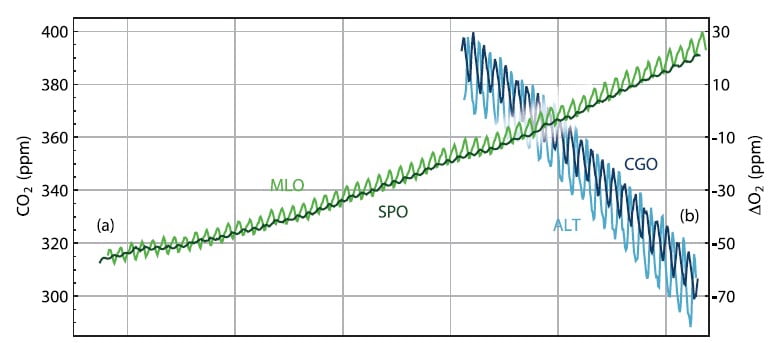
Naturally occurring gases in our atmosphere, such as carbon dioxide and methane, provide an insulating effect without which the earth would be a frozen planet. However, levels of greenhouses gases in the atmosphere have increased, preventing more heat escaping to Space and leading to ‘global warming’.
Any increases in the levels of greenhouse gases in the atmosphere mean that less heat escapes to Space and global temperatures increase – an effect known as ‘global warming’.
Over the past 150 years in the industrial era, human activities have increased the emissions of three principal green house gases: carbon dioxide, methane and nitrous oxide. These gases accumulate in the atmosphere, causing concentrations to increase with time.
Carbon dioxide (CO₂) has increased from our use of fossil fuels which we burn for use in transportation, energy generation, building heating and cooling. Deforestation also releases CO₂ and reduces its uptake by plants.
Methane (CH₄) has more than doubled as a result of human activities related to agriculture, natural gas distribution and landfills. However, increases in methane concentrations are slowing down because the growth of emissions has decreased over the last two decades.
Nitrous oxide (N₂0) is also emitted by human activities such as fertilizer use and fossil fuel burning.
Extra information
There are other, lesser, contributors such as CFCs (whose emissions have decreased substantially) and ozone in the lower atmosphere.
Water vapour is the most abundant and important greenhouse gas in the atmosphere. However, human activities have only a small direct influence on the amount of atmospheric water vapour. Indirectly, humans have the potential to affect water vapour substantially by changing climate as a warmer atmosphere contains more water vapour.
Aerosols are small particles present in the atmosphere with widely varying size, concentration and chemical composition. Fossil fuel and biomass burning have increased aerosols containing sulfur compounds, organic compounds and black carbon (soot).
What has caused the rise in temperatures over the past 100 years?
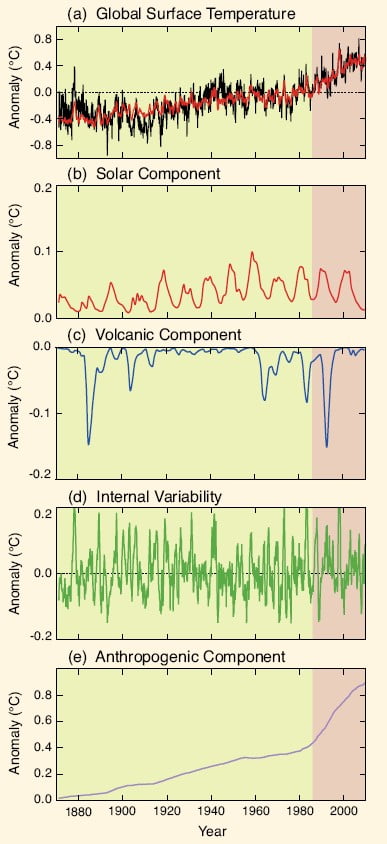
In the first half of the 20th century global temperatures have risen because of increases in the levels of greenhouse gases in the atmosphere as well as changes in the amount of energy emitted by the Sun. In the second half of the 20th century warming is mainly due to changing greenhouse gas concentrations.
Sulphate particles from industrial emissions reflect solar radiation and therefore act to cool climate. These particles helped mask the warming for a few decades from 1940, but then reductions in these pollutants together with ever increasing concentrations of greenhouse gases led to renewed warming from the 1970s.
What is the greenhouse effect?
 It is essential to human life! The natural greenhouse gas effect keeps Earth much warmer than it would otherwise be. Without the greenhouse effect, planet Earth would be too cold to support human life as we know it.
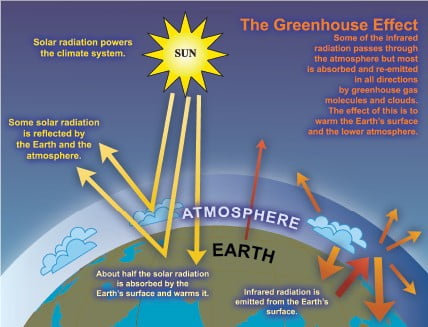
The temperature of the Earth is determined by the balance between energy coming in from the Sun in the form of visible radiation (sunlight) and energy constantly being emitted from the surface of the Earth to outer space in the form of invisible infrared radiation (heat).
The energy coming in from the Sun can pass through the clear atmosphere pretty much unchanged and therefore heat the surface of the Earth. But the infrared radiation emanating from the surface of the Earth is partly absorbed by some gases in the atmosphere, and some of it is re-emitted downwards. The effect of this is to warm the surface of the Earth and lower part of the atmosphere. This is called the greenhouse effect.
The absorbing gases in the atmosphere are primarily water vapour (responsible for about two-thirds of the effect) and carbon dioxide. Methane, nitrous oxide, ozone and several other gases present in the atmosphere in small amounts also contribute to the greenhouse effect. Without the greenhouse effect the Earth would be, on average, about 33°C colder than it presently is.
What other things can change the climate?
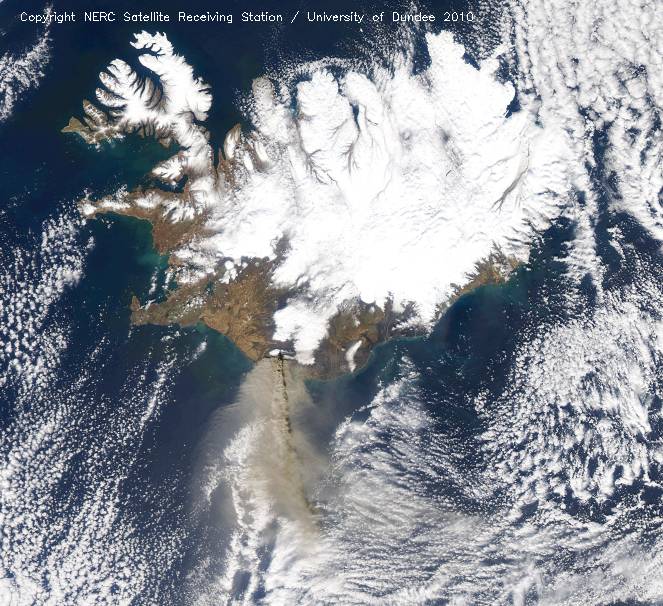
Well volcanic eruptions certainly play their part! There were three volcanic eruptions big enough to affect the climate in the 20th century.
There were 3 volcanic eruptions big enough to affect the climate in the 20th century – Agung in Indonesia (1963), El Chichon in Mexico (1982) and Pinatubo in the Philippines (1991).
Material (particles) from violent volcanic eruptions can be projected far above the highest cloud, and into the stratosphere where they can significantly increase how much incoming solar energy is reflected. Major volcanic eruptions can reduce average global surface temperature by about 0.5°C for months or even years.
However, volcanic eruptions are not the only factor that can influence the climate. There are three ways to change the radiation balance of the Earth:
by changing the incoming energy from the Sun, for example by changes in Earth’s orbit or in the Sun itself;
by changing the fraction of solar radiation that is reflected, for example by changes in cloud cover, vegetation or atmospheric particles such as volcanic material or sulphate aerosols;
by changing greenhouse gas concentrations, for instance, the amount of carbon dioxide in the atmosphere has increased by about 35% in the industrial era, and this increase is known to be due to human activities, primarily the burning of fossil fuels and removal of forests.
How do global changes relate to local changes?
Warming, particularly since the 1970s, has generally been greater over land than over the oceans. Seasonally, warming has been slightly greater in the winter hemisphere. A few areas have cooled but warming has been strongest over the continental interiors of Asia and northern North America. At the same time, eastern North and South America, northern Europe and northern and central Asia have been getting wetter but the Sahel, southern Africa, the Mediterranean and southern Asia have been getting drier.
Has the number of extreme events changed?
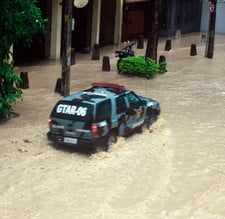 As the Earth’s climate gets warmer, the likelihood of some extreme events such as heat waves increases. Remember the European summer heat wave in 2003? Well, scientists believe, the risk of a similar summer has doubled due to human activities such as fossil-fuel burning.
Determining whether a specific, single extreme event is due to a specific cause, such as increasing greenhouse gases, is difficult for two reasons: 1) extreme events are usually caused by a combination of many different factors and 2) a wide range of extreme events is normal even in an unchanging climate.
However, we can talk about changes to the risk of extremes. The likelihood of some extreme events, such as heat waves, has increased with the changing climate, and the likelihood of others, such as extremely cold nights, has decreased. For example, a recent study estimates that human influences have more than doubled the risk of a very hot European summer like that of 2003.
In some regions there have been increases in droughts and floods. The number of days of very heavy rain have increased in some places. Tropical storm and hurricane frequencies vary considerably from year to year, but evidence suggests substantial increases in intensity and duration since the 1970s.
How has the climate changed in the past?

Northern hemisphere temperatures over the past 1000 years. Temperatures were warmer in the Medieval warm period (MCA) and colder in the Little Ice Age (LIA).
The Earth’s climate has always changed, long before we humans existed!
There have been warmer and colder periods. For example, in the last ice age, 20,000 years ago, it was about 9°C colder than it is now. The causes of most of these changes are very well understood.
How has the climate changed in the recent past?
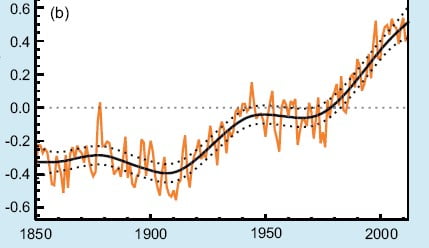
Current global temperatures are warmer than they have been during at least the past five centuries, probably for more than 1000 years. The 17 warmest years on record have all occurred in the last 20 years.
During the 20th century there have been two ‘warming phases’: from the 1910s to the 1940s (0.35°C), and more strongly from the 1970s to the present (0.55°C).
Alongside the warming, there has been an almost worldwide reduction in the extent and mass of glaciers in the 20th century. We know that the Greenland Ice Sheet is melting, that the thickness and extent of sea ice in the Arctic have decreased in all seasons and that sea level is rising due to thermal expansion of the oceans and melting of land ice.
Instrumental observations over the past 150 years show that air temperatures at the Earth’s surface have risen globally.
Why can’t we be sure what happened in the past?
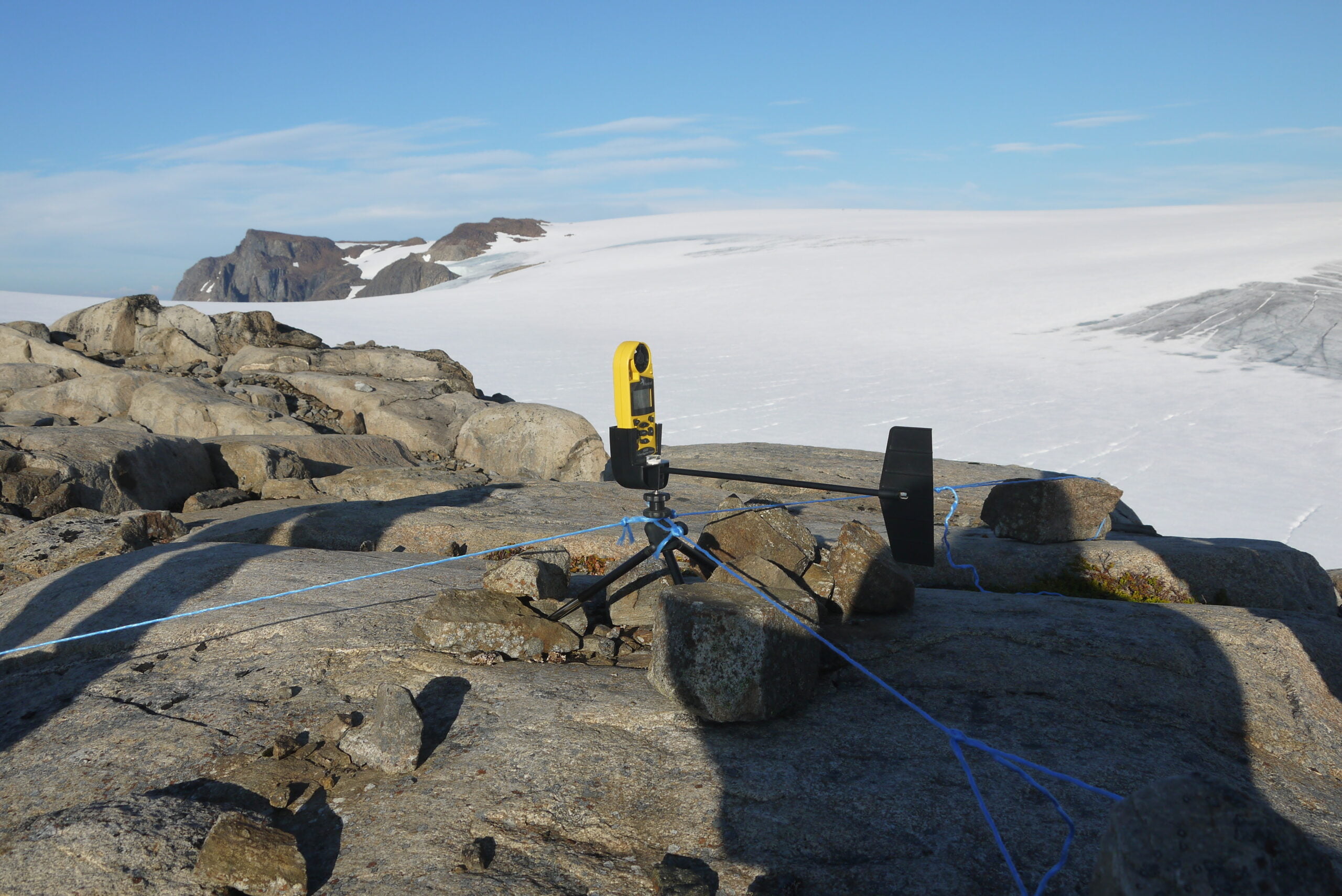 To know what was happening before 1850, we have to rely on what things like tree rings, fossils, and the gases trapped in ice cores tell us about local temperatures. This information is much less precise, and much less global, than for example the satellite data we have nowadays.
There is no single thermometer measuring the global temperature. Instead, individual thermometer measurements taken every day at several thousand stations over the land areas of the world are combined with thousands more measurements of sea surface temperature taken from ships moving over the oceans. These produce an estimate of global average temperature every month.
It is now possible to use these measurements from 1850 to the present, and although coverage is much less than global in the second half of the 19th century, it is much better after 1957 when measurements began in Antarctica, and best after about 1980, when satellite measurements began.
How can we make a climate prediction when we can’t forecast the weather for the next month?
 The chaotic nature of weather makes it unpredictable beyond a few days. To predict the weather you need to know exactly what is happening in the atmosphere down to the smallest scale. Climate is the average weather pattern of a region over many years (usually a period of 30 years).
Weather forecasts are very dependent on knowing exactly what is going on in the atmosphere, down to the smallest scales (it is ‘chaotic’), climate forecasts do not to the same extent.
Climate is the long term average of weather, including its variability. Climate predictions tell us about how the trends and patterns will change: will it be generally wetter in winter? Will there be more heavy downpours?
Projecting changes in climate due to changes in atmospheric composition or other factors is a much more manageable task than predicting the weather. As an analogy, while it is impossible to predict the age at which any particular man will die, we can say with high confidence what the average age of death for men is.
Similarly, a climate prediction might say that average summer rainfall over London is predicted to be 50% less by the 2080s; it will not predict that it will be raining in London on the morning of 23rd August 2089.
How do we make climate predictions?
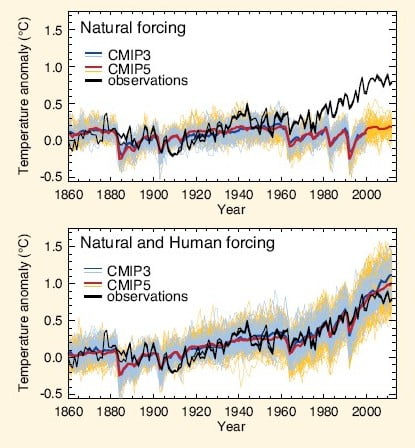
The only way we can project climate for the next 100 years, is to use very complex mathematical models. Some of the biggest models contain ten million lines of computer code and require some of the world’s largest super-computers to run them!
These complex mathematical models contain equations that describe the physical processes at work in the atmosphere, ocean, cryosphere (areas of ice and snow) and on land. We use changes in greenhouse gas, solar and volcanic emissions to drive the climate prediction models.
In the top graph the computer models only consider natural changes such as changes in the Sun and volcanoes, in the lower graph man-made changes such as greenhouse gas emissions are also considered. In that case the computer models do a good job of recreating past temperatures.
This gives us confidence for future simulations.
Scientists are confident that the models can provide useful predictions of future climate, partly because of their ability to reproduce observed features of current climate and past climate changes, such as the larger degree of warming in the Arctic and the small, short-term global cooling (and subsequent recovery) which has followed major volcanic eruptions, such as that of Mt. Pinatubo in 1991.
Why are some aspects of climate change harder to predict than others?
Believe it or not, it is much easier to predict global temperature than rainfall in Beijing, Jakarta, London or Mexico City! This is because, the smaller the scale of the physical processes involved, the harder something is to predict.
Climate models allow scientists to predict some aspects of climate change with much more confidence than others. For example:
averages over the whole Earth are easier to get right than very local changes;
temperature is easier than rainfall, which depends on the very small scale physical processes going on in clouds;
predicting how the climate will change in the relatively near future (within the next 40 years, say) is easier than further ahead, as we have a better understanding of what the world and the climate system will look like.
Why aren’t climate predictions exact?
There are many stages involved in making climate predictions. These include:
Each stage involves an increasing amount of uncertainty.
What are “climate feedbacks”?
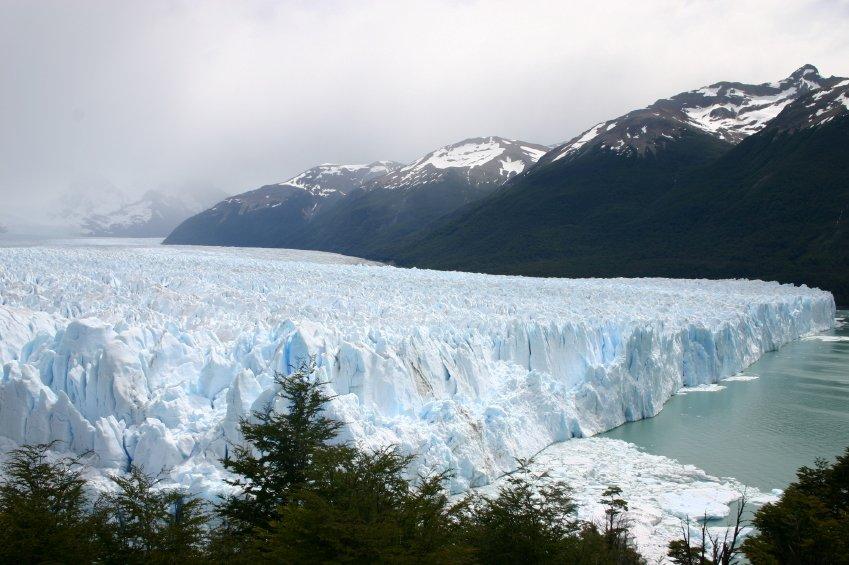 A climate feedback happens when an initial change in the climate system triggers a process that either intensifies or reduces the initial change.
Imagine snow and ice melting, exposing the darker land or water beneath. This land or water will now absorb more of the Sun’s energy, rather than reflecting it back into space. This causes warming. If it is warmer, there is more melting, more energy absorbed and then more warming and so on. This is an example of a positive feedback.
There are many feedback mechanisms in the climate system that can either amplify (‘positive feedback’) or diminish (‘negative feedback’) changes in the Earth’s climate. Here are two more examples:
Water vapour
The water vapour feedback in terms of the direct greenhouse effect is positive. As the atmosphere warms due to rising levels of greenhouse gases, its concentration of water vapour increases. As water vapour is a greenhouse gas, this in turn causes more warming. This feed back may be strong enough to approximately double the increase in the greenhouse effect due to the added CO2 alone.
Clouds
Clouds can amplify (increase – positive feedback) or diminish (decrease – negative feedback) warming. Clouds are effective at absorbing infrared radiation emitted from the Earth, re-radiating that energy (heat) back to the ground and therefore exert a large greenhouse effect, warming the Earth. However, clouds can also reflect away incoming solar energy, cooling the Earth. A change in almost any aspect of clouds, such as their type, location, water content, cloud altitude, particle size and shape, or lifetimes, affects the degree to which clouds warm or cool the Earth. Some changes amplify warming while others diminish it. The feedback of clouds can therefore be positive or negative depending on the circumstances.
Those feedback examples presented here are just a few of the feedback mechanisms which exist within the climate system.
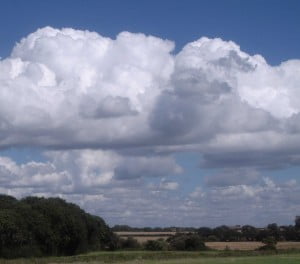
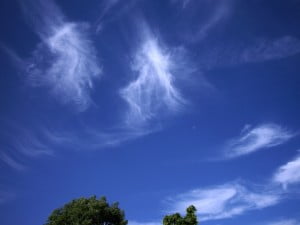
Low clouds (left) tend to cool the climate, high clouds (right) tend to warm the climate
How do we think extreme events will change?
They will vary from region to region. For example more flooding is expected in the Asian monsoon region and other tropical areas, future tropical cyclones could become more severe and there will be an increased risk of more intense, more frequent and longer-lasting heat waves in Europe.
Heat waves
The European heat wave of 2003 is an example of the type of extreme heat event lasting from several days to over a week that is likely to become more common in a warmer future climate. In pre-industrial times, the 2003 heat wave would have been a 1 in 1000 event. By the 2040s the average summer is predicted to be like the one we experienced in 2003; this in turn would be viewed as being relatively cold compared to the average summer temperature predicted for the 2060s.
Frost
It is also likely that a warmer future climate would have fewer frost days (i.e., nights where the temperature dips below freezing) and so the growing season is expected to get longer.
Rainfall and flooding
In a warmer future climate, most climate models project decreased summer rainfall and increased winter rainfall in most parts of the northern middle and high latitudes. Along with the risk of summer drought, there is an increased chance of episodes of intense rainfall and flooding. More flooding is also expected in the Asian monsoon region and other tropical areas and in a number of major river basins.
Cyclones
There is evidence from modelling studies that future tropical cyclones could become more severe, with greater wind speeds and more intense rainfall, although the actual number of cyclones may not change.
What about other aspects of climate, like rainfall, ice cover and sea level?
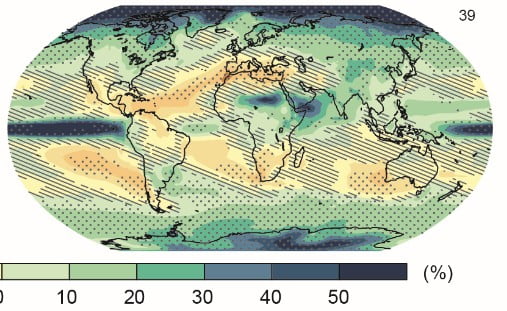
Many aspects of climate will change, not just temperature. Sea level is predicted to rise as the oceans get warmer and as some ice on land melts.
Rainfall
Most climate models predict that globally averaged rainfall will increase over time, with the biggest increases closes to the poles and in the Indian monsoon, and the smallest changes in subtropical regions.
Sea level
The two major causes of global sea level rise are water expanding as it warms and loss of land-based ice due to increased melting. Currently thermal expansion of the oceans is the main contributor to rising sea levels. The increasing melting of land-based ice is unlikely to have a significant effect on sea levels until 2100.
Note that, although sea ice (ice floating on the sea) has already started melting, and is predicted to melt more rapidly in the future, this does not affect sea level, as it is already floating and displacing its own weight in water.
Ice sheets
The two major ice sheets are the Greenland ice sheet and the Antarctic ice sheet.
The Greenland ice sheet contains enough water to contribute about 7 m to sea level. A sustained rise in local temperatures of about 3 °C (that’s global warming of about 1.5 °C) is likely to be reached by the end of the century if human-made emissions are not controlled. This would melt the Greenland ice sheet, although it would not happen immediately and it is estimated that this would take a few thousand years.
The West Antarctic ice sheet is the part of the Antarctic ice sheet most vulnerable to climate change. It contains enough water to contribute about 6m to sea level.
What are “tipping points”?
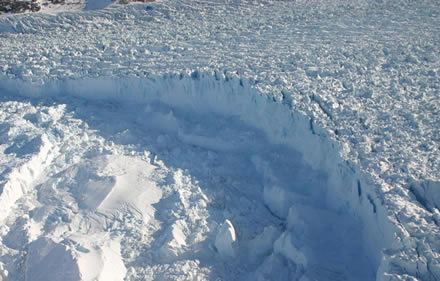 Tipping points refer to abrupt climate change. An example of abrupt climate change would be the rapid loss of the Greenland ice sheet. However, abrupt changes like this are not likely to occur in the 21st century.
The potential for climate to change relatively rapidly does exist. Abrupt climate change has occurred naturally in the past. A gigantic release of methane from below the ocean bed 56 million years ago led to a sudden warming of 6°C in the climate at a time when global temperatures were much higher than now. During the last ice age, collapses in the ice sheet over North America led to the Gulf Stream switching direction and the temperature across the North Atlantic dropping some 10°C within decades.
An important concern is that the continued growth of greenhouse gas concentrations in the atmosphere may trigger abrupt changes, which become more likely as the concentration of greenhouse gases in the atmosphere increases.
However, abrupt changes such as the collapse of the West Ant arctic ice sheet, the rapid loss of the Greenland ice sheet or large-scale changes of ocean circulation systems, are not considered likely to occur in the 21st century. As the total melting of the Greenland ice sheet, which would raise global sea level by about seven metres, is a slow process, it would take many hundreds of years to complete.
What do we think will happen to the temperature of the Earth?
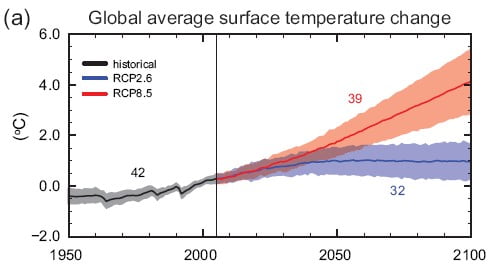
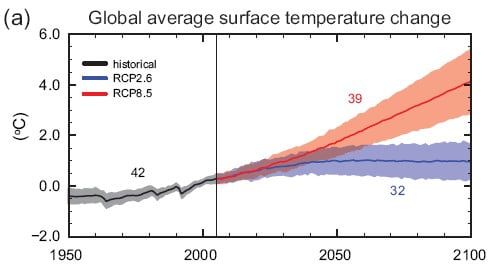
Global temperatures are likely to rise 2-4°C by the end of the 21st century. The actual temperature rise depends partly on how much greenhouse gas is emitted over the next 90 years.
The Intergovernmental Panel on Climate Change (IPCC) “best estimate” of global warming is 2-4°C by the end of the century. This may not seem like much but it is an average; it conceals a greater warming in some seasons and some areas (particularly at higher latitudes) and less in others, for example nearer the Equator.
In order to make projections about future climate change, scenarios that describe possible global emissions of greenhouse gases are used. These scenarios are based on different ‘storylines’ that illustrate how things may change in the future. They take into account different projected trends in population, economic and technological developments, as well as changes in the political environment. In the graph, the blue scenario is one where radical changes are made to greenhouse gas emissions immediately, whilst the red one is a scenario in which no emissions are reduced.
How do predictions for global temperature relate to what might happen locally?
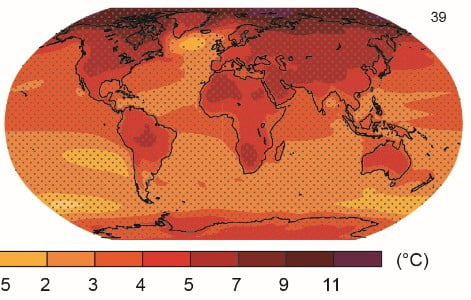
Climate varies from region to region. This variation is driven by the uneven distribution of solar heating, the individual responses of the atmosphere, oceans and land surface, the interactions between these, and the physical characteristics of the regions. Some human-induced factors that affect climate are global in nature, while others differ from one region to another. For example, carbon dioxide, which causes warming, is distributed evenly around the globe, regardless of where the emissions originate, whereas sulphate aerosols (small particles) that offset some of the warming tend to be regional in their distribution. As a result, the projected changes in climate will vary from region to region. For example, temperatures over land are expected to increase about twice as rapidly as temperatures over the ocean and warming will be greatest at higher latitudes. Similarly some areas will get wetter, whereas other areas will get drier.
If we stopped emitting greenhouse gases now, would the climate stop warming?
Two important factors mean the climate would not stop warming immediately.
Firstly, the adjustment of greenhouse gas concentrations in the atmosphere to reductions in emissions depends on the chemical and physical processes that remove each gas from the atmosphere. Concentrations of some greenhouse gases decrease almost immediately in response to emission reduction, while others can actually continue to increase for centuries even with reduced emissions. While they remain in the atmosphere, the gases continue to have an enhanced warming effect. For example, complete elimination of CO2 emissions would lead to a slow decrease in atmospheric CO2 concentrations through the 21st century.
Secondly, the surface of the Earth and especially the deep oceans take a while to adjust to new conditions, and so, even if the concentration of greenhouse gases in the atmosphere stops rising, the Earth’s surface will continue to warm for many years.
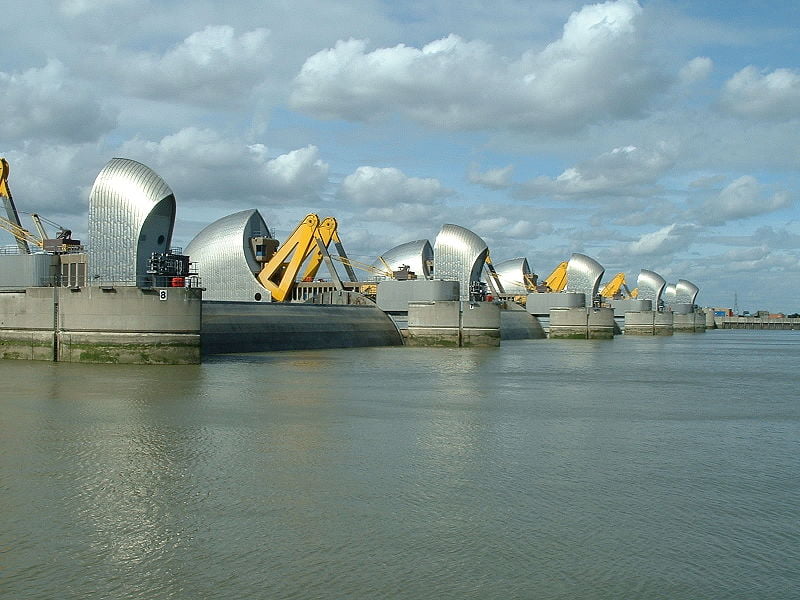
Flooding may result from a large amount of rain or from rapid thawing of snow and in coastal regions may also be caused by a storm surge or a combination of high tide and high river level. The consequences of flooding are often disastrous but there can also be beneficial effects of flooding.
 Storm surges are mainly caused by the effect of the wind on the sea, not changes in atmospheric pressure. The effect of wind on the sea surface is known as wind stress. The wind stress on the surface of the sea causes the water level on a coast to rise if the net transport of water is towards land and to fall if it is away from land.
Many coasts are at risk from storm surges and these include the Atlantic side of the United States, the Bay of Bengal area around India, Thailand and Indonesia, the coastal areas of the Netherlands and eastern England coastline. At the head of the Bay of Bengal large storm surges (up to 4m in height) are initiated by hurricane force winds coupled with low pressure tropical cyclone systems. Fortunately for the UK surges large enough to bring about catastrophic flooding of these North Sea coasts are experienced only a few times each century, and improved sea defences should stop all but the most extreme surges. On the Indian sub-continent, especially near the mouths of the River Ganges, death tolls from storm surges caused by tropical cyclones have been huge. In 1970, for example, more than 200,000 died when such a surge struck the area. Here, as in other places where storm surges occur, the sam
 Flooding of the Thames on 6th -7th January 1928 highlighted the need to find ways of forecasting storm surges. However, the real push to investigate storm-surges was on 31st January and 1st February 1953, when, a surge exceeding 2.7 metres at Southend in Essex and 3.5 metres in parts of Holland killed 307 people died in eastern England and 1,800 in the Netherlands. The storm that caused the 1953 surge was among the worst to hit the UK in the 20th century. Before the storm’s low pressure and storm-force northerly winds raised water levels in the southern North Sea, hurricane-force winds blew down more trees in Scotland than were normally felled in a year; and a car ferry, the Princess Victoria, on passage from Stranraer in Scotland to Larne in Northern Ireland, sank with the loss of 133 lives. Only 41 of the passengers and crew survived. Nowadays, surges are forecast with considerable accuracy and storm-surge barriers are in place in the most vulnerable places in the Low Countries and eastern England, one of them on the Thames a (south of Greenwich).
 When pressure falls by one millibar, sea level rises by one centimetre. Thus, a deep depression can cause sea level to rise 60 or 70cm above the level predicted purely on the basis of tidal theory. The pressure-induced rise in sea level caused by a tropical cyclone can be much greater, maybe a metre or more.
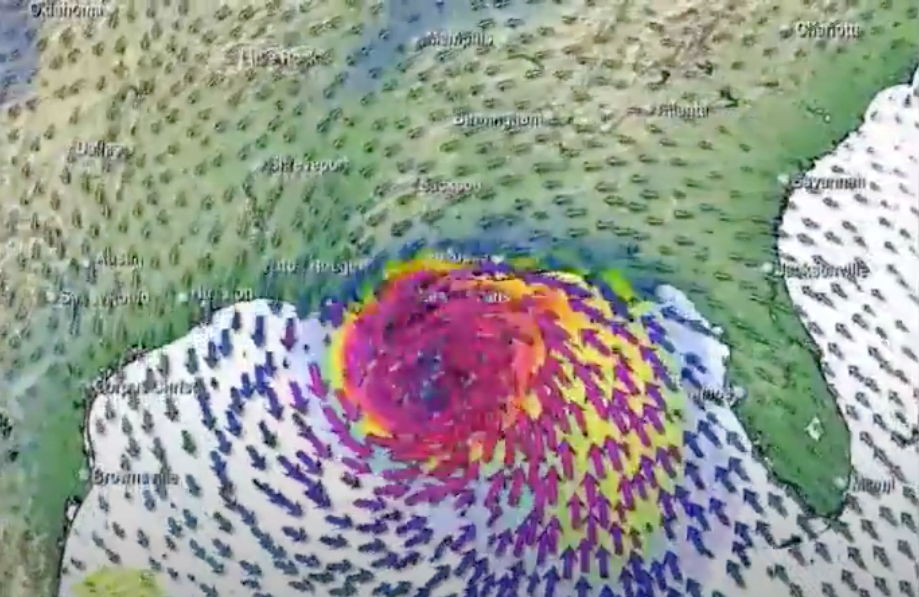
 One of the most energetic and destructive of all weather systems are tropical cyclones. The hurricane-force winds can reach 50m/s and torrential rain falls from their towering cumulonimbus clouds.flooding The winds can cause disastrous surges on coasts and the downpours of rain can cause serious flooding. Power and water supplies are disrupted, buildings are damaged, crops are destroyed, people and livestock are drowned, bridges collapse, roads and railways are undermined or blocked by debris, and beaches are scoured. Tropical cyclones nearly always leave behind a trail of destruction and misery.
 Flash floods are exceedingly dangerous. When water cannot percolate into the ground, it runs off the surface as it would from impermeable concrete. This is particularly so when the ground is very wet or when baked hard after a hot dry spell. Potholers can be especially at risk, such as on 24 June 1967, when five drowned in Yorkshire. The water which fell in a heavy thunderstorm after a spell of dry weather ran off rapidly into underground streams and caverns at Mossdale. The rise in water levels below ground was too rapid for the potholers to scramble to safety.
 In terms of water flow, the Mississippi is the sixth largest river in the world. Its annual average flow rate is 14,000 cubic metres per second and it discharges into the Gulf of Mexico 580 cubic kilometres of fresh water per year. The greatest flows occur in the period March to May and the least in the period August to October. A large proportion of the United States is drained by this river.
To protect against flooding, which would otherwise occur frequently, the Mississippi River is constrained by levees (embankments) all the way from the State of Missouri to the sea. This barrier, much of it concrete, has isolated the river from a lot of the surrounding countryside, but without it and other means of dealing with excess water in the river, low-lying cities such as New Orleans could not exist.
Tragically, some of the levees around New Orleans were breached on 29 August 2005 when they failed to withstand the battering imposed by the waves and a storm surge generated by Hurricane Katrina. Flood depths reached six metres in places and more than 1,000 people died.
Despite levees, spillways, reservoirs, pumping stations and other constructions, flooding does still occur. The flood-control system proved incapable of containing the flood of 1973, for example, and again proved inadequate in the summer of 1993, when abnormally high rainfall over central parts of the United States caused extensive flooding of the upper and middle Mississippi and lower Missouri rivers. The city of St Louis was particularly badly affected. Discharges of water from the Mississippi into the Gulf of Mexico in the late summer of 1993 were abnormally high. A study using satellite imagery showed that water from the Mississippi spread out far and wide off the States of Louisiana, Texas and Alabama. Indeed, some of the Mississippi water passed through the Florida Strait into the Atlantic.
 There was rain, more rain and even more rain in northern California soon after Christmas 1996. From 29 December 1996 to 4 January 1997, depression after depression from the central Pacific brought rain to northern California. As the air was unusually warm, a consequence of the precipitation was that large amounts of snow melted. During the week of the storms, 61 cm of rain was recorded. Significant flooding occurred in northern California and southern Oregon and 43 counties were declared disaster areas. Flooding occurred rapidly because soils became saturated and amounts of snowmelt were large. Flood-control reservoirs could not cope, as their storage capacity was no more than moderate because of near-normal rainfall and run-off prior to the onset of the severe weather. Levee failure occurred on several rivers.
After the United Kingdom’s snowy winter of 1947 came the thaw. In many parts of the British Isles in February and early March 1947, deep drifts of snow, some five metres or more deep, caused villages and hamlets to be cut off for days on end. Then, on 10 March, warm air and rain edged into south-west England and advanced across the British Isles. By 13 March, floods were widespread. Vast areas of Fenland, the Severn Valley and other parts of Britain were submerged. At Selby, Yorkshire, three-quarters of all the houses were under water. A severe south-westerly gale on 16 March drove water ahead and caused dykes in the Fens of eastern England to burst. Warm air and rain are much more effective at thawing large quantities of snow than sunshine. The albedo of old snow (proportion of light reflected) is about 55%. The albedo of fresh snow is about 80%.
On 9 and 10 April 1998, just before Easter, prolonged heavy rain fell over a wide area of Wales and central England. In the Midlands of England, there was serious flooding, with Northampton and Leamington Spa badly affected. In these Easter Floods, as they have come to be known, 4,500 homes were inundated, five people died and the estimated cost of the damage exceeded £350 million. The culprit was a slow-moving depression centred over Brittany. North of it, lying east-west across the Midlands, there were two parallel fronts which were almost stationary, producing prolonged heavy rain that fell on a catchment that was already saturated.
snowflakeIn coastal regions, flooding may be caused not only by a storm surge but also by a combination of high tide and high river level. An example of the latter occurred in South Wales in 1979. On 26 and 27 December of that year, falls of rain exceeded 100mm in many places, especially over the hills. Extensive flooding occurred on the 28th. Cardiff was badly hit when the River Taff in spate met a high tide from the Bristol Channel. Hundreds of homes and offices near the city centre were inundated. Flooding with sea water is bad enough, not least because the salt in the water is left behind when the water evaporates, but the flooding in Cardiff on this occasion was particularly unpleasant, as the water welled up into streets and houses through the sewers.
 In many parts of the world, there are serious health risks after disastrous flooding. Mosquitoes, flies and other insects may become more abundant than usual, as the filth, debris and stagnant water left by the floods provide suitable breeding conditions. Consequences may include out-breaks of typhoid, dysentery and encephalitis. Rats and mice displaced from their natural habitats may find conditions to their liking in houses, sheds, barns and other buildings.
 In some parts of the world, snakes also become a problem after flooding, as they, too, are displaced from their natural homes by the water. Quite often, they appear inside houses. However, snakes can be beneficial, as they help to reduce populations of rodents.
 Some of the most fertile land in the world lies beside rivers, the Nile valley being the classic example. For thousands of years, the people of Egypt have relied upon the waters of the Nile to overflow their banks every year, carrying with them fertile silt that makes agriculture possible. The flow of this river is nowadays controlled by means of the Aswan High Dam, an operation that can have its advantages and disadvantages. Salinity levels in the Nile Delta have increased, for example, because the outflow of fresh water from the river is much less now than before the High Dam existed. On the other hand, availability of water from the lake behind the dam, Lake Nasser, has allowed water levels downstream to be maintained in drought years, thus benefiting agriculture when in olden times crop failure and famine might have occurred.
 The Ganges Delta is another place where flooding brings benefits for agriculture. Here, every June to October, the waters of the Ganges, Brahmaputra and other rivers overflow and inundate the countryside. There is, however, no equivalent of the Aswan High Dam to control the waters of the Ganges Delta. Sometimes, crops are destroyed, hamlets ruined and humans and animals drowned.
In some arid regions (e.g. Namibia and central Australia), floods occur very occasionally. When they do, glorious displays of flowers follow. In these areas, seeds can lie dormant for many years and germinate (grow) very rapidly when the rains come.
 The heavy rains brought by tropical cyclones can help revive crops and replenish water supplies. Sometimes, fruit trees have flowered and borne fruit a second time after the passage of a cyclone. Sometimes, floods have flushed away mosquito breeding areas. There is a danger, however, that residual pools of water will, in turn, become mosquito breeding areas.
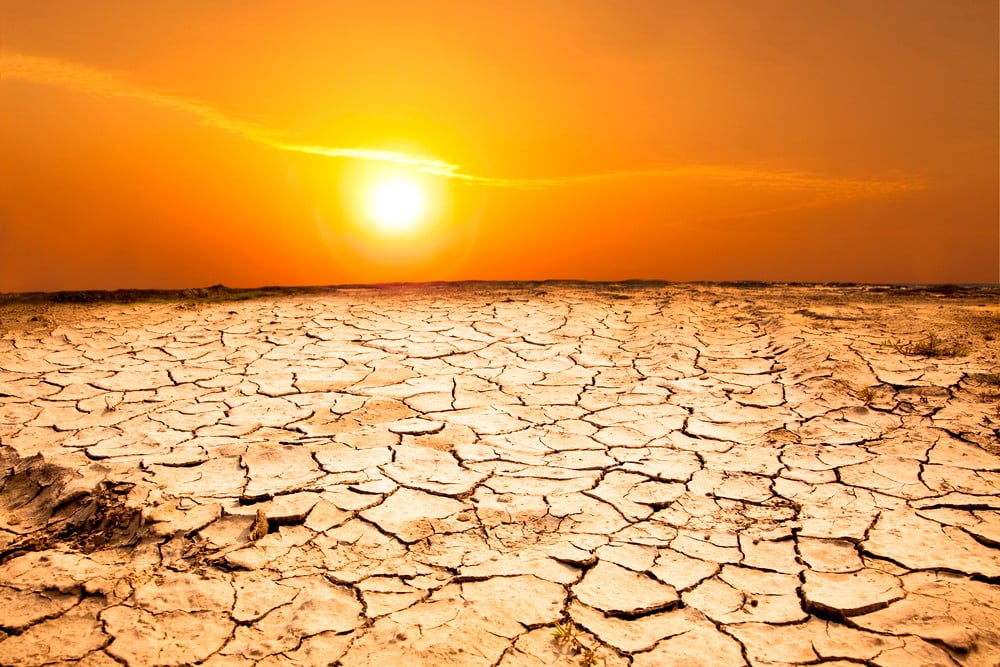
Droughts are not very easy to define. A drought is not just a lack of water for a period of time. In fact there are a whole range of types of drought including; agricultural (farming), meteorological (weather), hydrological (surface water) and socio-economic (ones which affect humans).
Agricultural Drought
 This is a drought which affects how farmers can use their land. An agricultural drought usually means there is not enough water for the crops to grow as there is a lack of soil moisture. It can also affect livestock such as cows and sheep.
Hydrological Drought
 Hydrological droughts are ones which there is a lack of water at the surface of the earth, resulting in less water in streams, lakes and reservoirs and can impact on the use of water for houses and industry
Meteorological Drought
 This is usually simply defined as a period of time where there has been less rain recorded. Rainfall amounts can vary by duration (i.e. time the rain fell for) and the intensity of rainfall (how hard it was raining). Meteorological drought is usually recorded in the time there has been little or no rain for e.g. months or years.
Socio-economic Drought
 A Socioeconomic drought is when physical water shortages affects the lives of people; such as their health and quality of life. It can also affect the supply of food and materials and so affect the economy.
What is a desert?
A desert is an area of land where rainfall is not sufficient to support vegetation. There are usually large temperature difference between day and night, known as the diurnal temperature range. Deserts can be hot or cold!
What is Desertification?
This is when an area on the boundary of a desert which loses its vegetation and the land becomes filled with sand dunes. Possible causes include climate change and variability, human pressure on the land and overgrazing by livestock (animals).
Where are the Main Deserts in the World?
Deserts are areas of very low rainfall and are often described as drought regions of the globe. But do you know where they are?

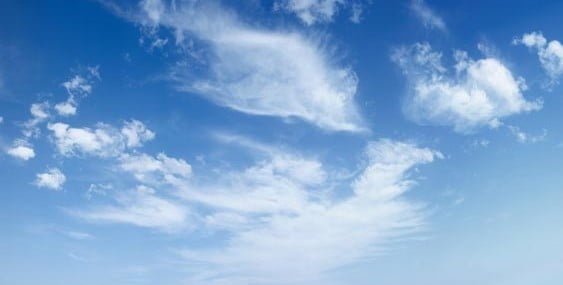
Air masses are parcels of air that bring distinctive weather features to the country. An air mass is a body or ‘mass’ of air in which changes in temperature and humidity within them are relatively slight. That is to say the air making up the mass is very uniform. in temperature and humidity.
An air mass is separated from an adjacent body of air by a weather front. An air mass may cover several millions of square kilometres and extend vertically throughout the troposphere.
A thin layer of mixed gases which covers the Earth and helps it from becoming too hot or too cold. Its circulation, the heat (terrestrial radiation) and light (solar radiation) which pass through it, and the processes which go on in it, all affect the climate. The atmosphere is about 800 km (500 miles) deep and is made up of 21% oxygen, 78% nitrogen, 0.037% carbon dioxide, and other gases including hydrogen, helium, neon, argon, krypton, xenon, and water vapour.

A classification of clouds was introduced by Luke Howard (1772-1864) who used Latin words to describe their characteristics.
There are now ten basic cloud types with names based on combinations of these words (the word ‘alto’, meaning high but now used to denote medium-level cloud, is also used).
Clouds form when moist air is cooled to such an extent it becomes saturated. The main mechanism for cooling air is to force it to rise. As air rises it expands – because the pressure decreases with height in the atmosphere – and this causes it to cool. Eventually it may become saturated and the water vapour then condenses into tiny water droplets, similar in size to those found in fog, and forms cloud. If the temperature falls below about minus 20 °C, many of the cloud droplets will have frozen so that the cloud is mainly composed of ice crystals.
The ten main types of cloud can be separated into three broad categories according to the height of their base above the ground: high clouds, medium clouds and low clouds.
High clouds are usually composed solely of ice crystals and have a base between 18,000 and 45,000 feet (5,500 and 14,000 metres).
Medium clouds are usually composed of water droplets or a mixture of water droplets and ice crystals, and have a base between 6,500 and 18,000 feet (2,000 and 5,500 metres).
Low clouds are usually composed of water droplets — though cumulonimbus clouds include ice crystals – and have a base below 6,500 feet (2,000 metres).
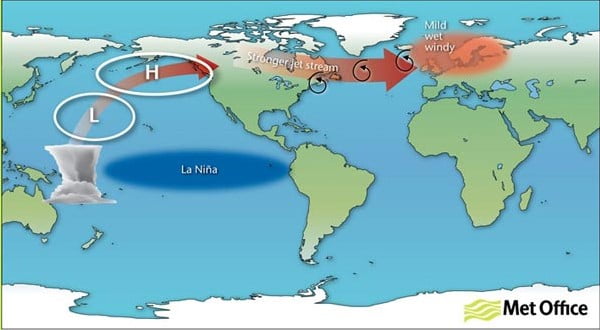
The tropical Pacific Ocean has a warming and cooling cycle. This cycle is a completely natural event and usually lasts between three to seven years. When the waters become warmer it is called El Niño, and when they become cooler it is called La Niña. During the cycle, the temperature of the ocean can change by around 3 °C between the warmest and coolest times.
Fishermen off the South American coast have known about this natural event for hundreds of years. When it happens, they see a huge fall in the numbers of fish caught. But scientists are only just beginning to understand how the event affects Earth’s weather and climate.
In an anticyclone (also referred to as a ‘high’) the winds tend to be light and blow in a clockwise direction. Also the air is descending, which inhibits the formation of cloud. The light winds and clear skies can lead to overnight fog or frost. If an anticyclone persists over northern Europe in winter, then much of the British Isles can be affected by very cold east winds from Siberia. However, in summer an anticyclone in the vicinity of the British Isles often brings fine, warm weather.
In a depression (also referred to as a ‘low’), air is rising. As it rises and cools, water vapour condenses to form clouds and perhaps precipitation. Consequently, the weather in a depression is often cloudy, wet and windy (with winds blowing in an anticlockwise direction around the depression). There are usually frontal systems associated with depressions.
Temperature affects other weather elements including air pressure, cloud formation, humidity and precipitation.
Factors affecting temperature:
A weather front is simply the boundary between two air masses.
There are three different types of weather front. These are:
Cold front
This is the boundary between warm air and cold air and is indicative of cold air replacing warm air at a point on the Earth’s surface
On a synoptic chart a cold front appears blue

The presence of a cold front means cold air is advancing and pushing underneath warmer air. This is because the cold air is ‘heavier’ or denser, than the warmer air. Cold air is thus replacing warm air at the surface. The symbols on the front indicate the direction the front is moving.
The passage of a cold front is normally marked at the earth’s surface by a rise of pressure, a fall of temperature and dew-point, and a veer of wind (in the northern hemisphere). Rain occurs in association with most cold fronts and may extend some 100 to 200 km ahead of or behind the front. Some cold fronts give only a shower at the front, while others give no precipitation. Thunder may occur at a cold front.
Warm front
This is the boundary between cold air and warm air and is indicative of warm air replacing cold air at a point on the Earth’s surface
On a synoptic chart a warm front appears red

The presence of a warm front means warm air is advancing and rising up over cold air. This is because the warm air is ‘lighter’ or less dense, than the colder air. Warm air is thus replacing cold air at the surface. The symbols on the front indicate the direction the front is moving.
As a warm front approaches, temperature and dew-point within the cold air gradually rise and pressure falls at an increasing rate. Precipitation usually occurs within a wide belt some 400 km in advance of the front. Passage of the front is usually marked by a steadying of the barometer, a jump in temperature and dew-point, a veer of wind (in the northern hemisphere), and a cessation or near cessation of precipitation.
Occluded front
These are more complex than cold or warm fronts. An occlusion is formed when a cold front catches up with a warm front
When a cold front catches up with a warm front the warm air in the warm sector is forced up from the surface
On a synoptic chart an occluded front appears purple

Weather can change on a daily basis especially at middle to high latitudes where it is controlled by weather systems, depressions and anticyclones.
On a weather chart, lines joining places with equal sea-level pressures are called isobars. Charts showing isobars are useful because they identify features such as anticyclones (areas of high pressure), depressions (areas of low pressure), troughs and ridges which are associated with particular kinds of weather.
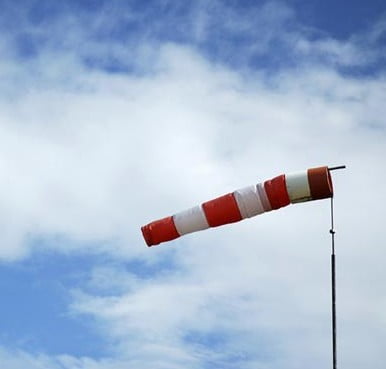
The movement of air around the earth from high pressure to low pressure is what brings about winds. The direction given for the wind refers to the direction from which it comes. For example, a westerly wind is blowing from the west towards the east.
Measurements of wind strength are made at 10 metres (33 feet) above the ground. A specified height has to be used because the wind speed decreases towards the ground. In this country winds are measured in knots (nautical miles per hour). However, forecast winds are often given in miles per hour (where 1 knot is equivalent to 1.15 mph) or in terms of the Beaufort Scale.
There are rapid variations in the wind – these are referred to as gusts. Gusts are higher inland than over the sea or windward coasts, although the mean wind speeds tend to be lower inland. Typically, gusts can be 60% higher than the mean speed, although in the middle of cities this can reach 100%. Northerly winds tend to be gustier than southerly ones. In general, the weather is strongly influenced by the wind direction, so information about the wind provides an indication of the type of weather likely to be experienced.
Web page reproduced with the kind permission of the Met Office
As air blows from high to low pressure in the atmosphere, the Coriolis force diverts the air so that it follows the pressure contours. In the Northern Hemisphere, this means that air is blown around low pressure in an anticlockwise direction and around high pressure in a clockwise direction.
Think about a person standing at the Equator. In the course of a day, the planet rotates once, meaning that you travel a colossal 2π x R (the radius of the Earth – 6370km) = 40,000km through space – a speed of about 1700km/ hr. You don’t notice that you are travelling so fast, because the air around you is travelling at the same speed, so there is no wind. On the other hand, if you are standing at a Pole, all you do in the course of a day is turn around on the spot, you have no speed through space and similarly the air around you is stationary.
Now, think about really fast moving, Tropical air which is being pulled towards the poles by a pressure gradient. As it travels polewards, it moves over ground which is rotating more slowly, and so it overtakes the ground, and looks like it is moving from west to east. Similarly, slow moving polar air will be left behind by the rotating Earth and look like it is moving from east to west if it is pulled equatorward by a pressure difference.
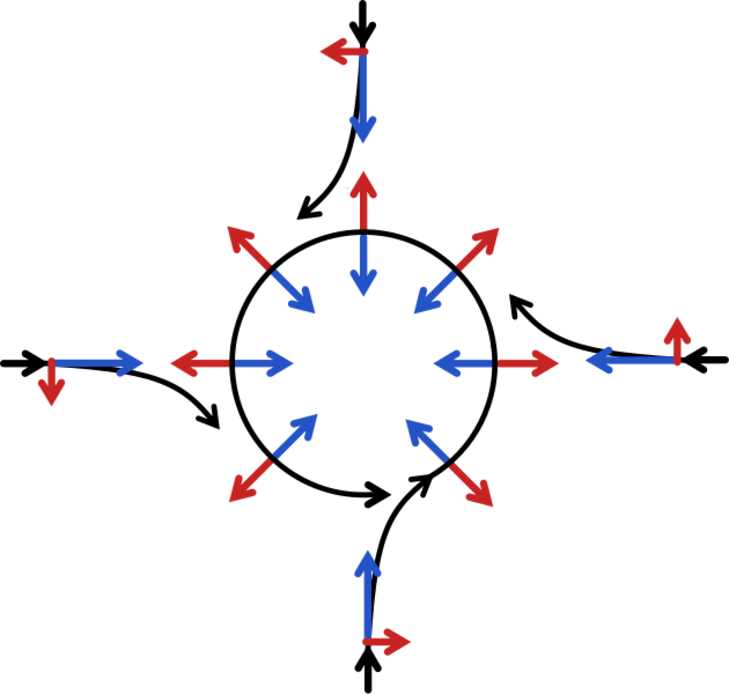
In general, moving air in the Northern hemisphere is deflected to the right by the Coriolis Effect.
As the air blows from high to low pressure the Coriolis force acts on it, diverting it, and we end up with air following the pressure contours and blowing around low pressure in an anticlockwise direction and around high pressure in a clockwise direction (both true only for the Northern Hemisphere).
In this diagram, the black arrows show the direction the air is moving in. The Coriolis force pulls the air to the right (red arrows). As the air is being pulled in to the depression by the pressure gradient (blue arrows), it is continuously deflected by the Coriolis Force. When the air moves in a circle around the depression, the Coriolis force (red arrows) is balanced by the pressure gradient force (blue arrows).
In summary, for the Northern Hemisphere:
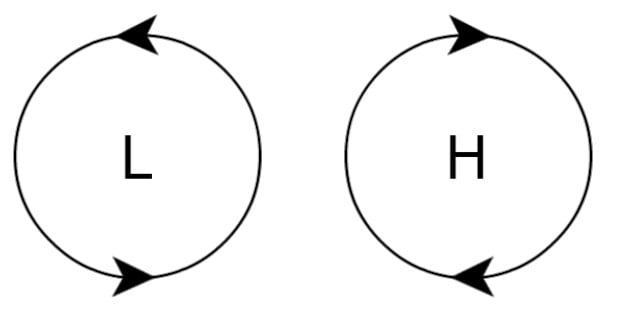
Figure 2: Air blows around a low pressure in an anticlockwise direction and around a high pressure in a clockwise direction in the Northern Hemisphere © RMetS
What about the Southern Hemisphere?
In the Southern Hemisphere, winds blow around a high pressure in an anticlockwise direction and around a low pressure in a clockwise direction.
The simplest way of visualising why this is the case is to take a ball (or an apple or orange, or anything spherical!). Mark on the poles and the equator, and then mark a spot in the ‘northern hemisphere’ and the ‘southern hemisphere’ of your sphere. Rotate your sphere. Keeping it rotating, tilt your sphere so that you are looking at it from the North Pole – your Northern Hemisphere spot should be going round in an anticlockwise direction. Now, making sure you keep rotating your sphere in the same direction, tilt it so that you are looking at the ‘south pole’. Your southern hemisphere spot should be rotating in a clockwise direction. This demonstration doesn’t explain the Coriolis effect, but it does show how things can be seen differently in the two hemispheres of the same planet.
Data and Image Sources
For an example of wind blowing along pressure contours, see the BBC website.
Useful Links:
Flooding is caused by:
Storm surges
Storm surges are caused by strong winds and low air pressure. When pressure decreases by one millibar, sea level rises by one centimetre. A deep depression, with a central pressure of about 960 mb, causes the sea level to rise half a metre above the level it would have been had pressure been about average (1013 mb). When pressure is above average, sea level correspondingly falls.
Storm surges create large waves. The highest waves wash away protective dunes, batter sea walls and break over coastal defences causing flooding.
The greatest surge on record for the North Sea as a whole occurred on 31 January and 1 February 1953.
A tropical cyclone is a low pressure system over tropical or sub-tropical waters, with convection (i.e. thunderstorm activity) and winds at low levels, circulating either anti-clockwise (in the northern hemisphere) or clockwise (in the southern hemisphere). The terms hurricane and typhoon are regionally-specific names for a strong tropical cyclone.


Most thunderstorms are associated with towering clouds known as cumulonimbus. The right conditions for the formation of a thunderstorm are unstable air and a mechanism for causing air to rise.
While air is rising it is said to be unstable. This instability is the result of a rapid fall of temperature with height, as well as a considerable amount of moisture in the air. This process may because by a warm surface; the air near the surface being forced to rise over higher ground or instability within a weather front.
E.g. on a summer’s day, the land is warmed by the sun, and as the air just above becomes warmer it starts to rise. As it rises it cools, and, if cooled sufficiently, cumulus clouds form at the condensation level. These small, white puffy clouds grow larger and larger as the temperature of the ground increases, causing more warm air to rise. After a time, the top of the cloud turns to ice (usually below a temperature of -20 °C) and streams away in the winds at the level of the cloud top, giving it a characteristic anvil shape.
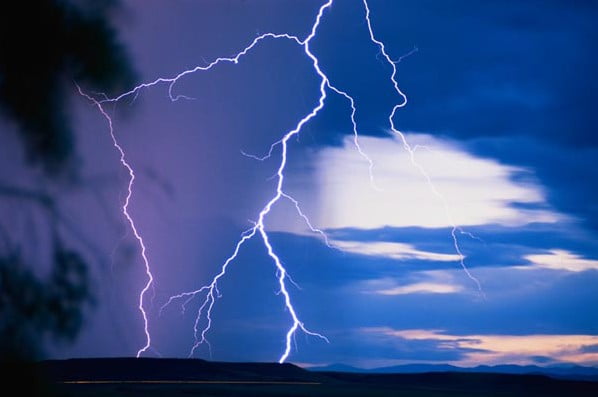
Lightning
Lightning is a large electrical spark caused by electrons moving from one place to another. Electrons cannot be seen, but when they are moving extremely fast, the air around them glows, causing the lightning flash. The actual streak of lightning is the path the electrons follow when they move.
An atom consists of three basic parts, a proton (which has a positive charge), a neutron (which has no charge) and an electron (which has a negative charge). Electrons cling to the positively charged centre of the atom because they have a negative electrical charge. During a thunderstorm, some of the atoms in the cloud lose electrons while others gain them.
When a cloud is composed entirely of water droplets, there is very little transfer of electrons. As a storm cloud grows in height, the water droplets higher up become cooler. They continue in the liquid state below 0 °C as super-cooled water, but eventually they begin to turn to ice, usually at a temperature below -20 °C. These ice particles often collide. When they do, smaller particles lose an electron to the larger, thereby gaining a positive charge.
The small particles are propelled towards the top of the cloud by strong internal winds, while the larger particles start to fall. This causes the top of the cloud to develop a strong positive charge.
The larger, negatively charged, ice particles begin to ‘capture’ super-cooled water droplets, turning them instantly to ice and growing, some reaching a sufficient size to start falling.
This leads to the base of the cloud becoming negatively charged which, in turn, induces a positive charge on the ground below. In time, the potential gradient between cloud and ground, or between adjacent clouds, becomes large enough to overcome the resistance of the air and there is a massive, very rapid transfer of electrons, which appears as a lightning flash.
Thunder
The word thunder is derived from ‘Thor’, the Norse god of thunder. He was supposed to be a red-bearded man of tremendous strength; his greatest attribute being the ability to forge thunderbolts. The word Thursday is also derived from his name.
Thunder is the sharp or rumbling sound that accompanies lightning. It is caused by the intense heating and expansion of the air along the path of the lightning. The rumble of thunder is caused by the noise passing through layers of the atmosphere at different temperatures. Thunder lasts longer than lightning because of the time it takes for the sound to travel from different parts of the flash.
You can roughly estimate how far away a thunderstorm is by measuring the interval between the lightning flash and the start of the thunder. If you count the time in seconds and then divide by three, you will have the approximate distance in kilometres. Thunder is rarely heard at a distance of more than 20 km.
Drought occurs when there is a lack of rainfall over a long period of time, resulting in water shortages for groups of people, activities or the environment. Droughts have a significant impact on agriculture and can harm the economy.
Causes of lack of rain

Web page reproduced with the kind permission of the Met Office
More links and images will be added to this page as they are identified.
A comparison between 1976 and 2018 from the BBC.
This fairly lengthy discussion from the Met Office has some good maps and statistics.
 Wildfires on Saddleworth Moor and Glenshane Pass, 27.6.18. Image reproduced with thanks from University of Dundee satellite receiving station.
And the corresponding Met Office chart, showing the High pressure/ polar continental conditions which dominated during the heatwave.
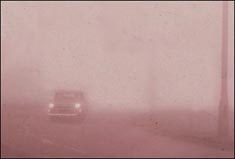
A fog so thick and polluted it left thousands dead wreaked havoc on London in 1952. The smoke-like pollution was so toxic it was even reported to have choked cows to death in the fields. It was so thick it brought road, air and rail transport to a virtual standstill. This was certainly an event to remember, but not the first smog of its kind to hit the capital.
Smog had become a frequent part of London life, but nothing quite compared to the smoke-laden fog that shrouded the capital from Friday 5 December to Tuesday 9 December 1952. While it heavily affected the population of London, causing a huge death toll and inconveniencing millions of people, the people it affected were also partly to blame for the smog.
During the day on 5 December, the fog was not especially dense and generally possessed a dry, smoky character. When nightfall came, however, the fog thickened. Visibility dropped to a few metres. The following day, the sun was too low in the sky to burn the fog away. That night and on the Sunday and Monday nights, the fog again thickened. In many parts of London, it was impossible at night for pedestrians to find their way, even in familiar districts. In The Isle of Dogs area, the fog there was so thick people could not see their feet.
Britain has long been affected by mists and fogs, but these became much more severe after the onset of the Industrial Revolution in the late 1700s. Factories belched gases and huge numbers of particles into the atmosphere, which in themselves could be poisonous. The pollutants in the air, however, could also act as catalysts for fog, as water clings to the tiny particles to create polluted fog, or smog.
When some of the chemicals mix with water and air, they can turn into acid which can cause skin irritations, breathing problems, and even corrode buildings. Smog can be identified easily by its thick, foul-smelling, dirty-yellow or brown characteristics, totally different to the clean white fog in country areas.
There are reports of thick smog, smelling of coal tar, which blanketed London in December 1813. Lasting for several days, people claimed you could not see from one side of the street to the other. A similar fog in December 1873 saw the death rate across London rise 40% above normal. Marked increases in death rate occurred, too, after the notable fogs of January 1880, February 1882, December 1891, December 1892 and November 1948. The worst affected area of London was usually the East End, where the density of factories and homes was greater than almost anywhere else in the capital. The area was also low-lying, making it hard for fog to disperse.
The weather in November and early December 1952 had been very cold, with heavy snowfalls across the region. To keep warm, the people of London were burning large quantities of coal in their homes. Smoke was pouring from the chimneys of their houses.
Under normal conditions, smoke would rise into the atmosphere and disperse, but an anticyclone was hanging over the region. This pushes air downwards, warming it as it descends. This creates an inversion, where air close to the ground is warmer than the air higher above it. So when the warm smoke comes out of the chimney, it is trapped. The inversion of 1952 also trapped particles and gases emitted from factory chimneys in the London area, along with pollution which the winds from the east had brought from industrial areas on the continent.
Early on 5 December, in the London area, the sky was clear, winds were light and the air near the ground was moist. Accordingly, conditions were ideal for the formation of radiation fog. The sky was clear, so a net loss of long-wave radiation occurred and the ground cooled. When the moist air came into contact with the ground it cooled to its dew-point temperature and condensation occurred. Beneath the inversion of the anticyclone, the very light wind stirred the saturated air upwards to form a layer of fog 100-200 metres deep. Along with the water droplets of the fog, the atmosphere beneath the inversion contained the smoke from innumerable chimneys in the London area.
 During the period of the fog, huge amounts of impurities were released into the atmosphere. On each day during the foggy period, the following pollutants were emitted: 1,000 tonnes of smoke particles, 2,000 tonnes of carbon dioxide, 140 tonnes of hydrochloric acid and 14 tonnes of fluorine compounds. In addition, and perhaps most dangerously, 370 tonnes of sulphur dioxide were converted into 800 tonnes of sulphuric acid.
The fog finally cleared on December 9, but it had already taken a heavy toll.
A series of laws were brought in to avoid a repeat of the situation. This included the Clean Air Acts of 1956 and 1968. These acts banned emissions of black smoke and decreed residents of urban areas and operators of factories must convert to smokeless fuels.
People were given time to adapt to the new rules, however, and fogs continued to be smoky for some time after the Act of 1956 was passed. In 1962, for example, 750 Londoners died as a result of a fog, but nothing on the scale of the 1952 Great Smog has ever occurred again. This kind of smog has now become a thing of the past, thanks partly to pollution legislation and also to modern developments, such as the widespread use of central heating.
Web page reproduced with the kind permission of the Met Office