Sylvia Knight, RMetS Head of Education, shares insights into the climate literacy of UK school leavers, common misconceptions in classroom and assessment resources, and opportunities for climate education in the science curriculum in an article for School Science Review (access restricted to subscribers).
In this blog Mike Jackson, Physics subject advisor, discusses cross-curricular links, support for understanding and possible misconceptions around climate education in physics with RMetS Head of Education, Sylvia Knight.
Geography is unique in its capacity to teach students about why and how climate change is happening, what the impacts of this are and how they vary across environments, places and people around the world, and how these impacts can be adapted to and mitigated against through actions locally and globally.
Geography’s integration of physical and human processes provides a distinctive curriculum context for the study of the interconnected aspects of climate change. However, underpinning all of this is an understanding of how weather and climate work, within the context of the whole climate system including the atmosphere, oceans, cryosphere and biosphere.
The physical processes which govern how weather and climate work depend on the concepts geography students will cover in their science lessons.
In a blog post for the Geographical Association and this summer’s Classroom Physics, Sylvia Knight looks at the synergies between science and geography and how the choice of contexts and examples in the former, and consistent vocabulary and explanations between the two can help develop students’ understanding and reinforce learning.
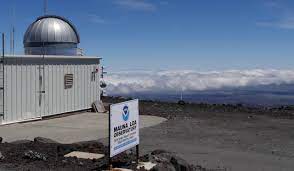
Bringing together learning from biology and chemistry topics in GCSE science, this new resource explores the seasonal cycle in atmospheric carbon dioxide concentrations as well as the year-on-year increase due to human activities.
Over the course of 2022 we produced questions for Isaac Physics, an online study tool developed by the University of Cambridge. Isaac Physics questions are self marking practice questions for secondary school and undergraduate scientists.
They cover a diverse range of applications of physics in weather and climate, including sea level rise, radar frequencies, aerosols, oceanic circulation, tidal barrages etc.
These questions are now live and fully searchable on the Isaac Physics website.
We have created a set of resources designed to allow physics teachers to demonstrate how the core physics taught links to current climate change research and action. For each topic, an expert in the field has recorded a short film which could be shown at the end of the lesson or topic. For some topics, practical activities or worksheets are also included:
Adapting the National Grid
We have a large and growing proportion of our electricity from renewables, and the amount of electricity generated varies depending on the weather. In this film, Jade Kimpton from the National Grid shows how the flow of electricity in the National Grid is getting more complex.
Key words: renewable and non-renewable energy, greenhouse gasses, fossil fuels, gravitational potential and kinetic store of energy.
Clouds reflect the Sun’s light, cooling the planet, but they can also act a bit like greenhouse gases, warming the planet. In this film, Dan Grosvenor from the University of Leeds shows how different types of cloud have a different climate effect.
The Jet streams are bands of fast winds high in the atmosphere which are driven by pressure differences. Stormy weather follows the jet stream. In this film, Tim Woollings from the University of Oxford shows how, as the lower atmosphere gets warmer, we need to understand how the patterns of pressure and the jet stream change and what effect that will have on storms in the UK.
Cathie Wells from the University of Reading is helping aircraft conserve fuel which reduces greenhouse gas emissions by making use of high resolution forecasts of three dimensional wind speeds in the atmosphere.
Key Words: speed, distance, time, velocity, greenhouse gas
Contrails occur when water vapour from jet engines condenses – only when the temperature and humidity conditions of the air is right. Contrails act like greenhouse gases. Marc Stettler from Imperial College, London is interested in guiding aircraft to fly where conditions are right, reducing contrail formation.
We have pulled together a set of Weather and Climate Change resources which could be used with a year 6 class after their SATs exams. Designed as a progressive set of engaging and interactive resources, they introduce skills and knowledge which will help prepare students for secondary school.
The resources can be used in independent lessons, or as part of a whole or half weather and climate themed day.
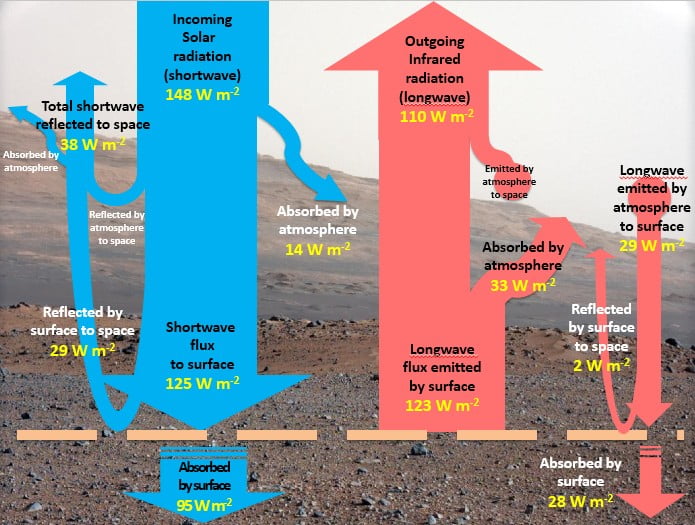
Establishing the radiation or energy budget of the Earth has been crucial to understanding climate change, but what do the radiation budgets of Mars and other planets in our solar system look like? Read about it in this article from Physics Review or this one from Science in School.
You can find the energy budget images for all the planets mentioned here.