Categories
Blog Geography Schools Teaching

RMetS work recognised

The Royal Meteorological Society’s collaboration with Time for Geography was recognised with the Highly Commended Geographical Association Publishers Award.

Time for Geography is the UK’s open-access, dedicated video platform for geography and geoscience education, developed in partnership with leading universities, employers and educational organisations.

The award recognises careers videos and resources developed to guide young people towards further study, training and careers connected to the weather & climate sector, and reflects the educational value of a collaboration designed to strengthen the future geography-geoscience talent pipeline.

The recognition comes as Time for Geography, in partnership with the Royal Meteorological Society and others, delivers the largest ever Geography-Geoscience careers intervention across UK schools and universities through its national and international audience. Having already reached an audience of over 2.5 million this academic year, the initiative is not only delivering scale, but is now also receiving national recognition from the educational community for the quality and value of what it is producing for students, teachers and schools. Through a Careers Insight Videos collection, Careers Explorer, Jobs and Opportunities Portal and Options and Open Days Pack, the collaboration is helping young people understand where geography can lead, how school and university pathways connect to careers, and what real opportunities exist in sectors such as weather & climate.

This work forms part of RMetS’ broader mission to support education and skills development across the weather and climate sector. By working collaboratively with partners, the Society seeks to strengthen the pipeline of future talent, ensuring that young people are better equipped to engage with – and contribute to – the challenges and opportunities presented by a changing climate.

Useful links:

Ellie Pinches, RMetS Education Officer, was also shortlisted for the Geographical Association’s Journal Award for her article in Teaching Geography which addresses eight of the commonest weather and climate misconceptions we have identified in teaching resources and assessment materials, and evidenced in responses to the Royal Meteorological Society’s annual climate literacy survey

The GA Journal Award is presented to articles which have made the greatest contribution to the development of good practice amongst geography teachers. 

Categories
Article Blog Curriculum Schools Science Teaching

Climate Education in the Science Curriculum

Sylvia Knight, RMetS Head of Education, shares insights into the climate literacy of UK school leavers, common misconceptions in classroom and assessment resources, and opportunities for climate education in the science curriculum in an article for School Science Review (access restricted to subscribers).

Categories
Article Blog Curriculum Schools Teaching

Ten-point plan to deliver climate education

Ten-point plan to deliver climate education in England unveiled by experts

Capitalising on greater climate change, nature and sustainability education in the national curriculum in England will need a detailed programme of support to make the changes a reality, according to a new report published today (Wednesday, 4 March).

The report, produced following discussions with more than 40 professional bodies and teaching organisations, sets out ten priority areas for improving climate education following the government’s Curriculum and Assessment Review.

The experts argue that while the curriculum review is a welcome step, real change will require coordinated support across the whole education system. It also urges Ofsted to incorporate schools’ sustainability actions and climate change, nature and sustainability education into their inspection framework.

Professor Sylvia Knight, Head of Education at the Royal Meteorological Society and a Visiting Professor at the University of Reading, said: “The curriculum review has created real momentum for change. We want to make sure that translates into effective climate education in every classroom. Having identified these ten priority areas we can now work together towards achieving them.”

The ten priority areas are:

  • Quality-controlling classroom resources — making sure materials from major publishers are accurate, up to date and adaptable for local use
  • Reforming exam specifications — ensuring climate and nature are examined across multiple subjects, with specifications that can be updated as the science develops
  • Expanding enrichment opportunities — ensuring all students have equal access to climate-related activities outside the classroom
  • Supporting teachers — better training and resources across all subjects, including guidance on handling controversial issues in the classroom
  • Defining essential content — making the basics of climate change causes, consequences and solutions compulsory for every student
  • Keeping the focus on solutions — more emphasis on renewable energy, nature restoration and green careers in lessons, training and exams
  • Improving coherence and sequencing — clearer links between subjects and year groups to avoid repetition and build on prior learning
  • Embedding green skills — weaving data, digital and critical thinking skills into climate and nature teaching across all subjects
  • Strengthening the wider community — closer working between publishers, subject experts, industry and young people
  • Applying a climate lens to every subject — bringing climate and nature into subjects beyond the obvious ones, and ensuring it is covered in teacher training from the start

The report ends by setting out a vision for what successful reform of the education system would look like by 2031. Contributors include the Royal Meteorological Society, the University of Reading, University College London, the National Association for Environmental Education, Global Action Plan, the Council for Subject Associations, the Royal Geographical Society and Cambridge University Press & Assessment.

Notes to editors:  

Read: Delivering High Quality Climate Change, Nature and Sustainability Education for All – Beyond the Curriculum and Assessment Review 

Professor Sylvia Knight is available for interview. Contact the RMetS Press Office on 0118 208 0142 or comms@rmets.org.

Additional quotes:

Professor Andrew Charlton-Perez, climate scientist at the University of Reading and chair of the National Climate Education Action Plan, said: “Climate change touches every part of our lives, so it makes sense that it should touch every part of the education young people receive. The reforms to the Science, Geography and Design and Technology curriculum are really welcome, but what our workshop highlighted is the distance still left to travel to ensure that the education system can deliver on these reforms. We highlighted ten priority areas we think need attention to make a real difference.” 

Dr Alison Kitson, Programme Director, UCL Centre for Climate Change and Sustainability Education at University College London, said: “Any reform to the education system needs to think clearly about what its end goals are. Our report highlights a collective vision for how they could improve the educational experience not just for young people but for teachers, school leaders and many others.”

Dr Morgan Phillips, Associate Director, Global Action Plan, said: “Our report highlights the careful thought, planning, and flexibility that is needed to weave climate change, nature and sustainability education into both the national curriculum and the education system more broadly. This requires collaboration and cooperation across subject disciplines and by curriculum makers at every level of the education system. It has never been more important to facilitate conversations between the department, the curriculum drafters, resource providers, exam boards and, of course, teachers and learners. This report highlights that these conversations are happening, they need to continue throughout the months and years to come.”  

Liz Moorse, Chief Executive of the Association of Citizenship Teaching and co-chair of the Council for Subject Associations said: “We must seize this unique moment in education policy to unite education leaders and subject teachers behind a shared mission: to teach environmental change, its impacts and the possible solutions for a more sustainable future. Our report sets out a vision to create a whole system approach so that no child is left without this essential education.”

Christine Ozden, the first Global Director for Climate Education, at Cambridge University Press & Assessment, said: “Today’s young people will inherit the most consequential impacts of climate change and the responsibility to respond to them. We want to support schools to empower them from reception up, so they have the expertise and ability to evaluate evidence, to think critically and to take on jobs in new industries shaped by a green economy.

“The UK Government’s recent Curriculum and Assessment Review made positive changes to integrating climate into education. Like the report authors, we see the opportunity and need to embed it right across the curriculum.

“This is an excellent report that shares and builds on the expertise and hard work of many people and organisations. Cambridge is proud to have contributed. We are already embedding climate education in our qualifications to ensure that this generation is equipped to contribute to local and global responses to the environmental changes that happen in their lifetimes. Climate change is the defining challenge of our age, and climate education is essential across the curriculum.” 

Myles McGinley, Managing Director of Cambridge OCR, said: “This timely report echoes what teachers and students tell us: they want to see more about climate change and sustainability in the curriculum.

“Just as climate change touches on every aspect of our lives, it should be present across a student’s education. This is more than just adding a worthy topic to the curriculum. Student engagement and attendance are increasingly challenging for many schools. Part of the solution is providing a curriculum that is engaging and relevant to young people and provides them with the knowledge and skills they need for life and work in a rapidly changing world.

“Today’s report notes that there will also be an important place for more climate-relevant qualifications. This is something we have found in the positive response to our certificate in sustainability, aimed at young people who are interested in the green economy. The curriculum, and qualifications available to young people, must never stand still.” 

Categories
Article Blog Science Teaching

How climate links to GCSE and A Level Physics specifications

In this blog Mike Jackson, Physics subject advisor, discusses cross-curricular links, support for understanding and possible misconceptions around climate education in physics with RMetS Head of Education, Sylvia Knight. 

Categories
Blog CPD Geography

The El Nino Southern Oscillation

In October 2025, Sylvia Knight, Head of Education at the RMetS, delivered a talk outlining the causes and impacts of ENSO to A level geography students for the Geographical Association in Northern Ireland.

With thanks to Niall Majury, the talk was recorded and can be viewed here

Find classroom resources related to El Nino here 

Categories
Blog CPD

CPD Opportunities

Some CPD opportunities coming up that the RMetS education team are delivering:

As part of the The Association for Science Education’s series of free climate change related CPD, we delivered an online session on
Climate Change Education: Up to date climate science for non-scientists
and on Climate Change Education: Climate Science for scientists in January 2026.

These talks were recorded and the recordings are available here

On 11th February, there is also an opportunity for those teaching OCR GCSE geography to pay for another online CPD session: Enhance your Teaching: Teaching Climate Change GCSE Geography A and B J383, J384.

There will also be an upcoming course on ‘introducing climate literacy in your curriculum’ with Hachette learning

Categories
Blog Research Secondary

Participate in the Climate Literacy Survey 2026

Survey open January - March 2026!

Get your students involved in the RMetS Climate Literacy Survey 2026!

Why?

Climate education is a vital driver of climate action, and is linked to the Paris Agreement, the COP process and future PISA education benchmarks.

By collecting data annually, we hope to build on our existing evidence of the state of climate literacy amongst school leavers in the UK and Crown Dependencies by:

  • Identifying regional and other variations in school leavers’ understanding of climate change and its impacts.
  • Tracking the impact of changing curricula and other education policies or national scale interventions on the climate literacy of school leavers.

In England, participating in the Climate Literacy Survey could form part of your school’s Climate Action Plan

We hope to be able to offer free, online teacher CPD to schools who contribute to data collection in 2026, including evidence collected from the survey. 

What?

  • The survey is quick, taking 5-8 minutes to complete.
  • Surveys should be completed individually and in school time. Students will need to have access to a device and be connected to the internet to participate.
  • There are 4 sections:
    • Section 1 : ‘About you’. A few questions about the participant.
    • Section 2 : ‘About your school’. A few questions about your school. Teachers should provide the school’s postcode.
    • Section 3 : Core questions. Every participant will be asked these 5 climate questions.
    • Section 4 : Randomly assigned questions. 5 questions will be randomly assigned to the participant.
  • No individual results will be fed back to participants or schools. Please stress to students that there is nothing to be gained by looking up answers or copying others’ responses.

Who?

The Climate Literacy Survey (CLS) is for secondary school leavers:

  • England, Wales, Jersey, Guernsey and Isle of Man – Year 11
  • Northern Ireland – Year 12
  • Scotland – S4

Data from other year groups will not be analysed. 

When?

The survey is open from 1st January –  31st March 2026.

Rules

If these rules are not followed data will not be included in analysis as it will not pass the data cleaning process.

The survey MUST:

  • Be completed online in school time.
  • Be completed individually, but within a class group setting, preferably a mixed ability, mixed subject class such as a tutor/ form group rather than an eco club. The survey is not curriculum linked or dependent in any way. 
  • Be completed by the correct age group.

Climate Literacy Survey reports to date:

Categories
Blog Curriculum maths Primary Teaching

Practice SATs Questions with climate context

RMetS have answered a call to make some KS2 SATs practice questions with authentic weather and climate contexts.

These questions are taken and adapted from the last three years of SATs papers (specifically maths papers 2 and 3), with numbers changed to fit in with the updated context.

Context is wide ranging. Some questions refer to wildflowers, insects and grow-your-own vegetables to connect with young people’s love of nature and to empower them to act positively towards nature and our climate. Other more obvious connections include questions about the seasons, flooding, public transport and renewable energy.

Questions have been broken down into topic and are in PDF form, and available as Word documents (to make it easy to copy and paste) together with the answers for teachers (or students to self or peer mark).

Primary Maths Blackboard
Categories
Careers Geography Snow

Met Careers Insight for Geographers

We’ve been delighted to support Time for Geography to produce video content which is now live and being viewed as bookends to Time for Geography videos in school and university learning environments.

Using the Tools of Geography, Maths and Science to predict and prepare for our weather

The RMetS careers video is also showcased as part of Time for Geography’s careers collection, where we feature titled videos aligned with career purpose and geography curriculum vocabulary. 

Time for Geography have been working with a national community of inspiring geography/ geoscience industry leaders who care deeply about the future of their profession and recognise this unique, strategic opportunity to repair and future-proof the talent pipeline at this critical tipping point.

Categories
Extreme weather Snow

When will it snow?

What are the requirements for snow?

There are three main requirements for snow, these are:

  1. Moisture

    There must be water vapour in the air for clouds to form. In the UK, surrounded as we are by sea, this is rarely a problem. As water warms up and cools down more slowly than land, the sea around us stays at a pretty constant temperature all year round and is a constant source of water vapour into the air above, through evaporation.

    It can be ‘too cold for snow’ in the centre of large land masses, such as Eurasia, Antarctica or N. America, where the wind has not encountered liquid water from which water can easily evaporate. It’s really ‘too dry for snow’ – but it’s too dry because it is so cold that the rate of evaporation from the lakes and rivers, which may be frozen, is very, very slow. 

  2. Cloud

    For clouds to form, the rate of evaporation must be lower than the rate of condensation. Evaporation and condensation are going on all the time, but the rate of evaporation falls as it gets colder. So, clouds can form when the air cools – there are several possible mechanisms for this

  • Where warmer air meets colder air at a front, causing it to rise. As the air rises, the air pressure falls and so the air cools (this is known as adiabatic cooling).
  • When air from somewhere colder than us (i.e. Arctic maritime of Polar Continental air masses) approaches the UK, is warmed from below as it travels over relatively warm land or sea which causes it to rise and cool. This is the most common source of snow in the UK.
  • When air is forced to rise over the coast, hills or mountains and, as it rises, cools. This mechanism can add to, or enhance, the formation of cloud by either of the other mechanisms above.
  • If the ground cools overnight, the air in contact with the ground can cool to the temperature at which cloud forms. This is fog and is not likely to produce rain or snow.
  1. Temperature

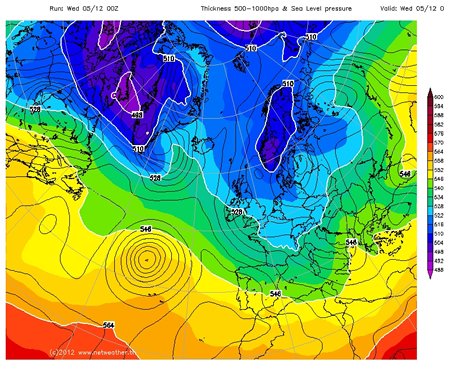
    It has to be cold enough for the cloud droplets to grow as snowflakes and to not melt as they fall through the atmosphere and down to the ground.  To see whether this is the case, forecasters look at the 528dam (=5280m) line. This line shows where the vertical thickness of the bottom half of the atmosphere (by mass) is 5280m i.e. the vertical distance between the 1000mb height (somewhere near the ground) and the 500mb height (somewhere in the middle of the troposphere). As warm air is less dense than cold air, the smaller this distance, the colder the air is.

If we are north of the line (i.e. the thickness is less than 528dam) then any precipitation can fall as snow, and if we are south of the line (i.e. the thickness is greater than 528dam) then we get rain.

If you look at the surface pressure forecast charts on the Met Office website, then if you go more than 24 hours into the future the thickness lines are shown. The 528dam line is shown as a blue dashed line, and the thicker/ warmer 546dam line as a green dashed line.

Another way to find out is to look at the weather forecast charts (in the charts and data menu) at http://www.netweather.tv/index.cgi?action=nwdc;sess= and select ‘HGT 500-1000’ from the ‘select chart type’ menu If the 528dam line is South of where you are, and there is a forecast of precipitation, then that precipitation is likely to be snow.

will it snow isobars
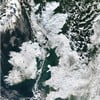
Image of the UK, 5th December 2012

It is also worth having a look at a cross section through the atmosphere for example at http://www.wetter3.de/ – select ‘Vertikalschnitte’ which gives a longtitude/ height cross section for 50N (move the pointer on the right side of the left hand map to change the latitude of the cross section). The air between the clouds and the ground has to be cold for snow to reach the ground.

Lesson Idea

Using the information above, can your students identify which countries/ regions should have a forecast of snow? At the basic level, they can just look and see where is inside the 528 line. More advanced students should try to predict where there will be precipitation. 

Nullschool is a great resource for visualising air flow and air masses. 

When do we get snow in the UK?

More information from the Met Office about Snow in the UK and forecasting snow.

A nice explanation of why we had such a different November in 2011 to the weather in November 2010 from the Met Office and a report on the 2010 snow and its impacts on the UK.

And an article from the BBC about what constitutes a white Christmas. 

Snow inspired science teaching ideas from Science in School.

White Christmas – an article from MetMatters

Snow inspired geography teaching ideas from the GA.

How to make a snowflake, from the Institute of Physics

From Brilliant Maps; the probability of a white Christmas across Europe

MetLink - Royal Meteorological Society
We use cookies on this site to enhance your user experienceBy clicking any link on this page you are giving your consent for us to set cookies. More info

By clicking any link on this page you are giving your consent for us to set cookies. More info