
Categories
Extreme weather Snow

When will it snow?

What are the requirements for snow?

There are three main requirements for snow, these are:

  1. Moisture

    There must be water vapour in the air for clouds to form. In the UK, surrounded as we are by sea, this is rarely a problem. As water warms up and cools down more slowly than land, the sea around us stays at a pretty constant temperature all year round and is a constant source of water vapour into the air above, through evaporation.

    It can be ‘too cold for snow’ in the centre of large land masses, such as Eurasia, Antarctica or N. America, where the wind has not encountered liquid water from which water can easily evaporate. It’s really ‘too dry for snow’ – but it’s too dry because it is so cold that the rate of evaporation from the lakes and rivers, which may be frozen, is very, very slow. 

  2. Cloud

    For clouds to form, the rate of evaporation must be lower than the rate of condensation. Evaporation and condensation are going on all the time, but the rate of evaporation falls as it gets colder. So, clouds can form when the air cools – there are several possible mechanisms for this

  • Where warmer air meets colder air at a front, causing it to rise. As the air rises, the air pressure falls and so the air cools (this is known as adiabatic cooling).
  • When air from somewhere colder than us (i.e. Arctic maritime of Polar Continental air masses) approaches the UK, is warmed from below as it travels over relatively warm land or sea which causes it to rise and cool. This is the most common source of snow in the UK.
  • When air is forced to rise over the coast, hills or mountains and, as it rises, cools. This mechanism can add to, or enhance, the formation of cloud by either of the other mechanisms above.
  • If the ground cools overnight, the air in contact with the ground can cool to the temperature at which cloud forms. This is fog and is not likely to produce rain or snow.
  1. Temperature

    It has to be cold enough for the cloud droplets to grow as snowflakes and to not melt as they fall through the atmosphere and down to the ground.  To see whether this is the case, forecasters look at the 528dam (=5280m) line. This line shows where the vertical thickness of the bottom half of the atmosphere (by mass) is 5280m i.e. the vertical distance between the 1000mb height (somewhere near the ground) and the 500mb height (somewhere in the middle of the troposphere). As warm air is less dense than cold air, the smaller this distance, the colder the air is.

If we are north of the line (i.e. the thickness is less than 528dam) then any precipitation can fall as snow, and if we are south of the line (i.e. the thickness is greater than 528dam) then we get rain.

If you look at the surface pressure forecast charts on the Met Office website, then if you go more than 24 hours into the future the thickness lines are shown. The 528dam line is shown as a blue dashed line, and the thicker/ warmer 546dam line as a green dashed line.

Another way to find out is to look at the weather forecast charts (in the charts and data menu) at http://www.netweather.tv/index.cgi?action=nwdc;sess= and select ‘HGT 500-1000’ from the ‘select chart type’ menu If the 528dam line is South of where you are, and there is a forecast of precipitation, then that precipitation is likely to be snow.
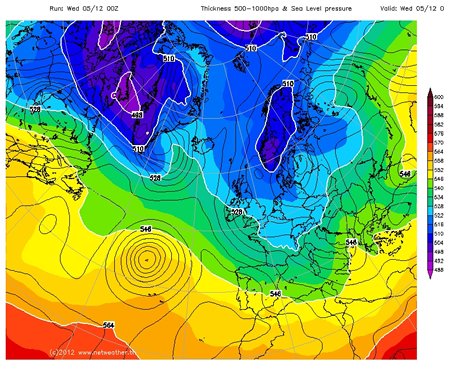
will it snow isobars
Image of the UK, 5th December 2012

It is also worth having a look at a cross section through the atmosphere for example at http://www.wetter3.de/ – select ‘Vertikalschnitte’ which gives a longtitude/ height cross section for 50N (move the pointer on the right side of the left hand map to change the latitude of the cross section). The air between the clouds and the ground has to be cold for snow to reach the ground.

Lesson Idea

Using the information above, can your students identify which countries/ regions should have a forecast of snow? At the basic level, they can just look and see where is inside the 528 line. More advanced students should try to predict where there will be precipitation. 

Nullschool is a great resource for visualising air flow and air masses. 

When do we get snow in the UK?

More information from the Met Office about Snow in the UK and forecasting snow.

A nice explanation of why we had such a different November in 2011 to the weather in November 2010 from the Met Office and a report on the 2010 snow and its impacts on the UK.

And an article from the BBC about what constitutes a white Christmas. 

Snow inspired science teaching ideas from Science in School.

White Christmas – an article from MetMatters

Snow inspired geography teaching ideas from the GA.

How to make a snowflake, from the Institute of Physics

From Brilliant Maps; the probability of a white Christmas across Europe

Categories
Blog Schools

Results of 2025 Climate Literacy Survey

From January – June 2025 the Royal Meteorological Society (RMetS) again collected data to evidence the climate literacy of school leavers (S4 in Scotland, year 11 in England/ Wales, year 12 in N. Ireland) across the UK. This built on the data collected by the DfE in 2024 (https://www.gov.uk/government/publications/climate-literacy-amongst-school-leavers), which in turn built on the surveys run by the RMetS in 2022 and 2023.  

This survey is a very important piece of evidence about the state of climate awareness amongst our young people, as well as the key gaps in the climate education they are currently receiving, at a time when the curriculum is being reviewed, refreshed or developed in all 4 Nations of the UK.

Key differences from the 2024 data were that

  • The full set of 55 questions were used in all 4 Nations of the UK. Last year, only the ‘core’ set of 5 questions were used in Scotland and Wales.
  • Instead of working with Ipsos to collect data, we recruited schools through our own communication channels as well as those of our partner organisations. As a result, the data was less well sampled and particularly biased towards Independent girls’ schools in England.

The differences in the results we obtained may therefore be because of the greater representation of students particularly from Scotland, less representative data or changes over time. However, we would not yet expect to see curriculum changes (e.g. in Wales) over the last few years to be reflected in the data we have collected.

Unfortunately, no usable data was collected from Northern Ireland.

National differences may reflect differences in curricula but can also be influenced by local issues, priorities and communication.

Students in England are more likely to remember having learned about climate change in the previous two years of education (65%), than those in Scotland or Wales (45%), who may not have learned about climate change since primary school.

2025 RMetS climate literacy survey age last taught

We saw a dramatic increase in the number of students correctly identifying the meaning of ‘Net Zero’ from 10% in 2024 to 46% in 2025, albeit with national differences – although 54% of respondents in England could select the correct answer, only 33% could in Wales. This is a phrase which is in widespread use, by politicians, schools and employers, and an improvement in understanding may be due to improved coverage by the media.

We found an increase in the number of students reporting concern about climate change with 23% of respondents said they are ‘very’ concerned this year, compared to 12% in 2024 and similar values in England, Scotland and Wales. In contrast to last year, more students report being concerned about climate change than not concerned. As in other studies, we see a larger number of girls reporting that they are ‘very’ or ‘fairly’ concerned about climate change.

Unsurprisingly, there remains a correlation between those school leavers who think that climate change will affect them directly and those who are concerned about climate change.

In designing climate education and communication strategies, we rightly consider the need to avoid developing climate anxiety but we should make sure that our focus is on making young people ‘concerned and hopeful’ as only this will lead to effective individual and collective climate action.


2025 RMetS climate literacy survey level of concern

One important way to do this is through demonstrating the relevance of climate change to young people, their communities and careers.  However, the data collected in the survey shows continuing very low awareness of climate change in the UK, including projected impacts as well as adaptation and mitigation strategies already in place or needed.

Related to this, there was low awareness of the extent of existing renewable energy production in the UK. This will be directly relevant to school leavers’ awareness of the green careers and wider climate action available to them. Students in Scotland, which has the highest number of on-shore wind turbines in the UK, are more likely to recognise that wind power is being used to generate a lot of electricity than in England, whereas students in England are more likely to recognise solar power.  

Over 75% of students still do not appreciate that future global warming can still be limited or avoided, highlighting an opportunity for increasing ‘hope’ in climate action amongst young people, again missing messages about hope and green careers.

Some specific issues related to current curricula and the siloing of climate change in geography were highlighted by the survey. For example, respondents had poor awareness of the fact that the expansion of water as it warms has contributed roughly as much to sea level rise as the melting of ice. This argues for the need for a curriculum which encourages the application of knowledge and understanding (in this case, learning in science that liquids expand when they are heated) to real world contexts (sea level rise). Another example relates to the fact that only 55% of students recognised that respiration was a source of carbon dioxide, suggesting that many could not relate learning about organisms to the wider global carbon cycle.

Another example relates to the current KS3/ 4 geography curriculum in England where the disproportionate amount of time devoted to teaching past climate change and in particular the Milankovitch cycles seems to have led to respondents overestimating the impact of natural forcing mechanisms on recent climate change. For the first time, we have enough data to compare responses between Nations. Students in England were least likely to recognise that over 80% of warming since the Industrial Revolution has been caused by humans (24% in England, 28% in Scotland, 33% in Wales). Students in England were also most likely to say that sunspots could affect the temperature of the Earth ‘a lot’ (24% in England, 11% in Scotland) and that changes in the Earth’s orbit around the Sun could affect the temperature of the Earth ‘a lot’ (58% in England, 37% in Scotland).

2025 RMetS climate literacy survey human contribution to warming

The number of students correctly identifying that the vast majority (over 97%) of scientists agree about the causes of climate has increased substantially from last year (37% from 22%), although most respondents still think scientific consensus is significantly lower than it actually is. This potentially relates to the use of the ‘evaluate’ command word in geography assessments (most frequently seen in N Ireland and England), which necessitates students to present arguments from both sides even if, in reality, the debate is essentially one sided. Students in Wales were least likely to recognise scientific consensus.


2025 RMetS climate literacy survey scientific consensus

However, reassuringly, the responses indicated that students place a relatively high level of trust in their science and geography teachers as sources of climate change information. This reinforces the need for teachers to have the time and support to keep their own subject knowledge up to date and relevant. 


2025 RMetS climate literacy survey trust in sources

There remains poor understanding and awareness of adaptation and mitigation strategies generally, and in particular of effective ways to reduce climate change. The impacts of keeping pets and eating meat on greenhouse gas emissions are generally underestimated whereas the impact of switching lights off and recycling (from the point of view of greenhouse gas emissions) is overestimated. This potentially reflects the impact of decades of teaching the ‘easier to handle’ aspects of sustainability, particularly in primary schools and highlights misconceptions about the efficacy of personal actions and their contribution to GHG emissions. This relates to the common focus in schools on personal carbon footprints rather than those of goods, services and organisations.  A focus on personal carbon footprints can generate feelings of guilt, lack of agency, or disengagement whilst, as we have highlighted, focussing on actions which in practice have little impact on greenhouse gas emissions. There was particularly low awareness of nature-based solutions to climate change.

Climate justice recognises the fact that the people and countries most vulnerable to climate change are often not the ones who have done the most to cause it. Respondents indicated a good awareness of which countries are currently emitting most greenhouse gas, but less awareness of per capita or historical emissions. Similarly, there was limited understanding of regional variations in future temperature changes and their impacts. This may be evidence of a ‘case study’ approach to teaching in geography, with focus on one or two countries without putting them in context with our own country, or the global whole. Knowledge rich understanding should develop learning which can be applied beyond the specific case studies or examples considered in assessment specifications.

One clear message that has emerged from the survey every year, is how poorly the 1.5°C/ 2°C key climate goals are understood. This year, only 15% of students could correctly identify the meaning of the goal (a similar proportion to last year). When asked how much the Earth has warmed since the pre-industrial period, although very few (17%) selected the correct answer, 1.1-1.4°C,  we saw a shift in the mode from 2.7°C -2.8°C in 2024, to 1.5°C-1.6°C in 2025 with also far fewer students selecting that they did not know the answer. Students in Scotland were more likely to overestimate current global warming or responded that they did not know the answer.

Categories
Blog Curriculum

RMetS Response to CAR Review

Categories
Climate Change Teaching

Climate Change Quality Controlled Resources

The following resources have been assessed against the Quality Control framework , climate change content, and meet the criteria:

November 2025

Megawatt game and associated teaching resources 

October 2025

Geogramblings Improving Climate Literacy in the Geography Classroom CPD course

April 2025

Engineering UK Climate schools programme resources

Educake questions

February 2025

Twinkl Climate change CPD. 

December 2024

SOS-UK Teach the Teacher presentation 

September 2024

Twinkl Eco Adventurers scheme, Earth’s Climate & Cycles resources for EYFS – Year 6. 

June 2024

AQA Climate Change and Sustainability in GCSE science

April 2024

Common Seas Education/ Plastic Clever schools secondary resources

March 2024

Engineering UK Tackling Climate Change

January 2024

Royal Meteorological Society with Dr Frost Learning

Secondary Maths Resources

December 2023

National Education Nature Park

What is the Anthropocene?

Climate change: making change

Climate change and mental health

Carbon cycle passport

Making change

Royal Meteorological Society with the Royal Geographical Society

Resources based on the 2021/ 2022 IPCC report for A level and GCSE geography

Royal Meteorological Society with the Young People’s Trust for the Environment

Heatwaves

Royal Meteorological Society with Mathematics Education Innovation (MEI)

Maths Climate Change Resources

Royal Meteorological Society

Climate change concept association tool

Carbon dioxide – seasonal cycles

Weather and Climate: a Teachers’ Guide

Royal Meteorological Society/ National Education Nature Park

Agree or disagree

UK Climate

The great debate

Greenhouse effect bulldog

Met Office/ National Education Nature Park

Exploring climate change data

Interpreting climate change models

Climate change P4C activities

Emotion line graphs

Royal Geographical Society/ National Education Nature Park

What is the difference between weather and climate?

Why is our climate like this?

Can climate change?

What will climate be in the future?

Does it matter if climate changes?

Royal Society/ National Education Nature Park

What do you want to know about climate change?

Thoughtbox/ National Education Nature Park

Changing climates

Changing climate cause and effects

Be the change

Phet/ National Education Nature Park

Greenhouse effect

Eden Project/ National Education Nature Park

Climate response

WWT/ National Education Nature Park

Climate champions

UCAR/ National Education Nature Park

Project drawdown

The Quality Control framework was developed as part of the National Climate Education Action Plan and in partnership with other organisations. 

MetLink - Royal Meteorological Society
We use cookies on this site to enhance your user experienceBy clicking any link on this page you are giving your consent for us to set cookies. More info

By clicking any link on this page you are giving your consent for us to set cookies. More info